
The barrier to building software has collapsed. It didn’t crumble slowly. It vanished overnight.
Vibe coding tools have fundamentally shifted the bottleneck of software development. The constraint is no longer your knowledge of TypeScript or Python. The constraint is now how clearly you can articulate your vision and how effectively you can manage the AI that executes it.
But with the explosion of vibe coding platforms comes a new form of paralysis. The market is flooded with tools promising to turn a single sentence into a SaaS unicorn. Some are genuine engineering marvels that integrate deeply with modern frameworks. Others are glorified wrappers that generate “slop,” code that looks functional on the surface but falls apart under the stress of real-world usage.
If you choose the right tool, you gain the output of a senior engineering team for the cost of a monthly subscription. Choose the wrong one, and you will spend weeks debugging hallucinated libraries and untangling spaghetti code that you didn’t write and don’t understand.
This guide dissects the top vibe coding tools on the market. We aren’t just listing features. We are evaluating them based on code integrity, deployment architecture, and the specific limitations that only appear after you have committed to a workflow.
How to Choose a Vibe Coding Tool
Before comparing specific platforms, you must identify where you sit on the technical spectrum. The market has bifurcated into two distinct categories, and choosing the wrong category is the most common mistake new builders make.
Category 1: Prompt-to-Website (The “Magic” Layer)
These tools function like a conversational wish-fulfillment machine. You describe a “CRM for dog walkers,” and the tool generates the database schema, the frontend UI, and the backend logic in one shot.
- Best for: Founders, marketers, internal tool builders, and rapid prototyping.
- The Trade-off: You surrender control. If the AI hallucinates a dependency or hardcodes a variable, you often lack the access to fix it manually without “ejecting” the code, which usually breaks the magical drag-and-drop interface.
Category 2: AI-Assisted Development (The “Power” Layer)
These are fully featured Integrated Development Environments (IDEs) infused with agentic AI. You still see file trees, terminals, and syntax highlighting. The AI acts as a pair programmer that can write 80% of the code, but you are expected to understand how to run a local server or manage a Git repository.
- Best for: Developers, technical founders, and those who need production-grade scalability.
- The Trade-off: The learning curve remains. The AI can write the code, but if the build fails, you need to know how to read the error log.
Quick Decision Tree
- Do you know how to open a terminal and run npm install?
- Yes: Go to AI-Assisted Development (Cursor, Replit).
- No: Go to Prompt-to-Website (Lovable, Bolt, Base44).
- Is this a disposable prototype or a long-term product?
- Disposable: Prompt-to-Website.
- Long-term: AI-Assisted Development, or plan to export code from a prompt tool later.
Prompt-to-Website Platforms
These platforms represent the purest form of vibe coding. They abstract away the file system and the terminal, allowing you to iterate purely through conversation.
Lovable
The Visual App Generator
Lovable has rapidly become the standout choice among vibe coding tools for non-technical founders. Unlike generic chatbots that spit out code snippets, Lovable builds entire React applications with a Supabase backend integration handled automatically.
What it does best:
Lovable excels at visual refinement. Its “Edit Mode” allows you to click on a generated element, like a button or a pricing card, and prompt changes specifically for that component. This solves the “context window” problem where restating a prompt to fix a button might accidentally break the navigation bar. It feels less like coding and more like directing a designer who works at light speed.
Technical Reality Check:
Lovable relies heavily on pre-built component libraries, typically Shadcn/UI and Tailwind CSS. This ensures the apps look modern and clean by default. However, complex logic often trips it up. If you ask for a multi-step authentication flow with specific role-based access controls, Lovable may generate a UI that looks like it works but lacks the backend security rules to actually enforce it. The “happy path” works perfectly, but edge cases are often ignored.
The Atarim Synergy:
Lovable builds fast, but it doesn’t check for usability. It is easy to generate a visually stunning app that is completely inaccessible to screen readers or has confusing user flows.
- The Workflow: You use Lovable to generate the MVP in an afternoon.
- The Quality Layer: You use Atarim to scan the generated site. Atarim’s AI agents act as the “Senior Designer” and “Accessibility Lead,” flagging low-contrast text or broken navigation paths that Lovable’s AI inserted blindly.
Bolt.new
The Browser-Based Full Stack
Bolt.new, developed by the team at StackBlitz, is technically impressive because it runs the entire development environment inside your browser. It doesn’t just generate code. It runs a Node.js server in your Chrome tab using WebContainers.
What it does best:
Bolt is currently the leader in handling full-stack context. It can switch between editing a backend API route and a frontend React component in the same context window. It is particularly strong at debugging its own errors. If a build fails, Bolt can often read the terminal error and self-correct without you needing to intervene. It essentially automates the debugging loop that usually frustrates junior developers.
Technical Reality Check:
Bolt defaults to the Remix framework. While powerful, this is an opinionated stack. If you try to force it to use libraries it isn’t familiar with, it can enter a “death spiral” of hallucinated imports. Additionally, while the code is portable, the proprietary nature of the prompt history means you are somewhat locked into their ecosystem until you decide to download the zip file and walk away.
The Atarim Synergy:
Bolt gives you speed, but Atarim gives you confidence. When Bolt says “Deployed,” it means the server is running. It does not mean the product makes sense.
- The Workflow: Build the SaaS platform in Bolt.
- The Quality Layer: Connect Atarim to the deployed URL. Use the “Claro” agent to review the site as a first-time user, ensuring that the copy generated by the AI actually explains the product clearly, rather than using generic placeholder text.
Base44
The Internal Tool Specialist
Base44 targets a specific niche within the vibe coding platform market. It focuses on internal business logic. While Lovable and Bolt aim for consumer-facing apps, Base44 is optimized for dashboards, admin panels, and data entry tools.
What it does best:
It connects logic to data. If you need a tool that takes a CSV upload, processes it using OpenAI’s API, and saves the result to a database, Base44 is often faster than Bolt or Lovable because it has pre-built connectors for these workflows. It feels less like “coding” and more like “logic assembly.” It bridges the gap between a no-code tool like Zapier and a custom React app.
Technical Reality Check:
The visual customization is limited compared to Lovable. You are often trading design flexibility for functional reliability. It is not the right tool for a consumer-facing landing page where pixel-perfect branding matters. The generated UIs are functional and utilitarian, designed for employees rather than customers.
The Atarim Synergy:
Internal tools are notorious for terrible UX because “only employees will use it.” This leads to operational inefficiency.
- The Workflow: Assemble the admin panel in Base44.
- The Quality Layer: Run an Atarim audit to ensure the workflow is intuitive. Just because it is an internal tool doesn’t mean it should be confusing. Atarim can flag confusing labels or illogical step sequences that would frustrate your team.
AI-Assisted Development Platforms
For those who want to build production-grade software that scales beyond an MVP, these tools offer the best balance of AI speed and engineering control.
Cursor
The Professional Standard
Cursor is a fork of VS Code. If you have ever used VS Code, you already know how to use Cursor. It is widely considered the best vibe coding tool for professional engineers because it respects the developer’s existing workflow while supercharging it with AI.
What it does best:
Cursor’s “Composer” feature (Cmd+I) allows you to edit multiple files simultaneously. You can say, “Add a ‘Subscribe’ field to the User model, update the database migration, and add the input field to the settings page,” and Cursor will calculate the changes across your backend, database, and frontend files simultaneously.
It also supports .cursorrules—a file where you can give the AI permanent instructions. You can enforce rules like “Always use Tailwind for styling” or “Never use any in TypeScript.” This enforces code standards that other tools ignore.
Technical Reality Check:
Cursor is an editor, not a host. You still need to deploy your app to Vercel, AWS, or Railway. You are responsible for environment variables, CI/CD pipelines, and database management. If the AI writes a slow SQL query, you are the one who has to pay the bill or fix the latency.
The Atarim Synergy:
Cursor handles the code. Atarim handles the experience. A developer using Cursor is often hyper-focused on syntax and logic, missing visual bugs.
- The Workflow: Write the code in Cursor, push to GitHub, deploy to Vercel.
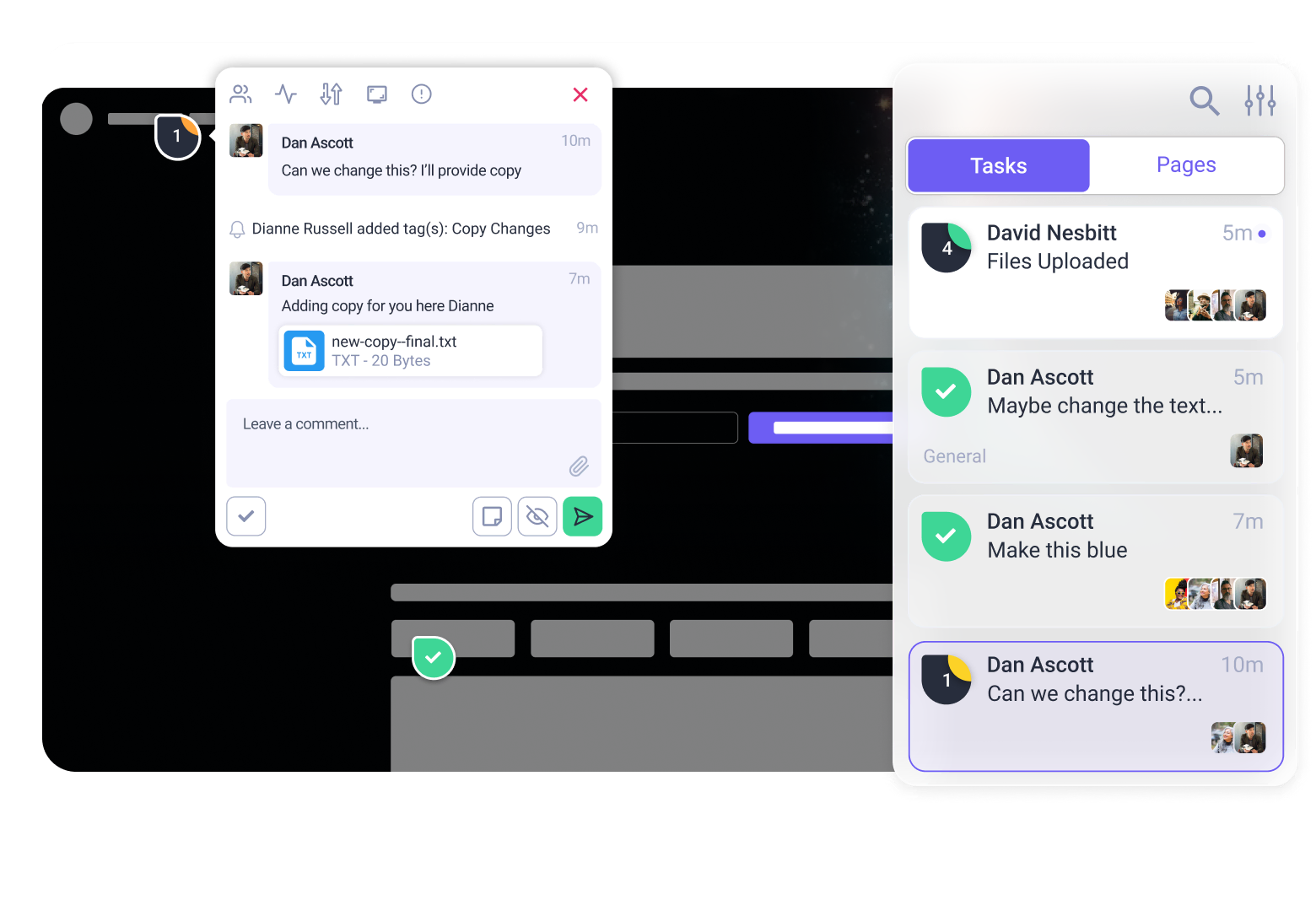
- The Quality Layer: The moment the Vercel preview URL is live, Atarim sits on top of it. You can mark visual bugs directly on the live site (“This padding is wrong on mobile”) and feed those tasks back into Cursor to fix. It creates a closed loop between visual QA and code execution.
Replit
The Zero-Setup Environment
Replit began as an online IDE but has evolved into a formidable vibe coding platform with the introduction of “Replit Agent.”
What it does best:
Replit is the fastest path from “idea” to “URL.” Because the hosting is built-in, you don’t need to configure Vercel or Netlify. The Replit Agent can plan complex multi-step tasks, execute them, debug the errors, and deploy the result without you typing a line of code. It effectively automates the “Junior Developer” loop of write-test-fix.
Technical Reality Check:
Replit’s ease of use comes with a “walled garden” cost. Moving a complex project off Replit later can be difficult due to its specific configuration files and database handling. It is fantastic for MVPs and side projects, but scaling a Replit app to handle millions of users requires significant architectural changes.
The Atarim Synergy:
Replit encourages “deployment via prompt.” This is dangerous. It is easy to deploy a version of your app where the “Delete Account” button doesn’t actually work because the AI mocked the UI but forgot the backend logic.
- The Workflow: Let Replit Agent build and deploy the app.
- The Quality Layer: Use Atarim’s “Glitch” agent (QA specialist) to crawl the site. It verifies that links aren’t broken, buttons are interactive, and the site doesn’t crash on standard interactions, catching the functional gaps the Replit Agent missed.
Comparison Matrix
To summarize the landscape, here is how the top vibe coding platforms stack up against one another.
| Platform | Best For | Technical Skill | Deployment | The Risk Factor |
| Lovable | Non-technical founders wanting beautiful UIs | Very Low | Built-in | High: Great visuals can mask broken logic or security gaps. |
| Bolt.new | Full-stack prototypes & startups | Low | Built-in | Medium: Can enter “death loops” of errors; proprietary lock-in. |
| Base44 | Internal business tools | Very Low | Built-in | Medium: Limited design control; strictly for utility apps. |
| Cursor | Pro devs & scalable products | Medium/High | External (Vercel/AWS) | Low: You own the code, but you own the bugs too. |
| Replit | Hackathons & rapid deployment | Low | Built-in | Medium-High: Hard to migrate away; encourages “lazy” review. |
The Tool Doesn’t Matter if the Output is Broken
There is a fundamental truth about vibe coding that most tool comparisons ignore. AI is a sycophant.
Whether you use Cursor, Lovable, or Bolt, the AI wants to please you. If you ask for a “blue button,” it will give you a blue button. It will likely not tell you that:
- The blue button has insufficient contrast against the background (Accessibility failure).
- The button label “Click Here” is bad for SEO (Strategy failure).
- The button creates a database entry but fails to validate the input (Security failure).
- The button doesn’t work on Safari (QA failure).
This is the Quality Gap.
In traditional software development, you have a Senior Developer doing code review, a QA Engineer testing functionality, and a Designer checking the UI. In vibe coding, you fired all those people and replaced them with a prompt.
The Role of the Quality Layer
You cannot rely on the builder to be the auditor. The tool that wrote the code is biased toward thinking the code is correct.
This is why a tool-agnostic quality layer is essential for anyone serious about shipping vibe-coded products. Atarim occupies this role. It doesn’t care which tool you used to build the website. It cares about the result.
By integrating Atarim into your vibe coding stack, you effectively re-hire that team of experts:
- Pixel (Design Agent): Checks the visual consistency of your Lovable app.
- Navi (Accessibility Agent): Ensures your Bolt.new prototype is legally compliant.
- Glitch (QA Agent): Hunts for broken flows in your Replit deployment.
Closing the Loop
The future of software is not just about who builds the fastest. It is about who builds the fastest without breaking things.
The “Junior Developer” that is AI needs supervision. You can try to do it all yourself, manually clicking every link, checking every viewport, and reading every line of generated code, or you can automate the oversight just as you automated the build.
Whichever vibe coding tool you choose, do not ship blindly. Get expert feedback on your AI-built site for free with Atarim.