


Who made Jaws?
Steven Spielberg, right?
Except he didn’t hold the camera. He didn’t build the sets. He didn’t cut the film. Hundreds of people did all of that, and most of us couldn’t name one of them.
The taste, the final call, the name on the poster? His.
And nobody has ever once said the director didn’t make the movie.
I think about that a lot, because there’s a version of this argument that agency owners have with themselves constantly and almost always lose.
The day I stopped doing the work
I learned this years before AI turned up, on the day I made my first hire.
He was a designer, and he was good. And the first thing that happened was that I felt slightly fraudulent. Work was going out under my agency’s name that I hadn’t drawn. I’d briefed it, I’d set the standard, I’d sent it back twice before I was happy with it. But my hands weren’t on it.
It took me an embarrassingly long time to understand what had actually happened that day.
That was the day I stopped getting paid for my hands and started getting paid for my judgement.
Which is a promotion. It just doesn’t feel like one at the time, because the thing you were proud of — being the one who could do it — quietly stops being the thing you’re valuable for.
That’s where a lot of people are sitting right now with AI, and it’s why the conversation gets so emotional. It isn’t really a conversation about tools. It’s a conversation about what you are if you’re not the one doing it.
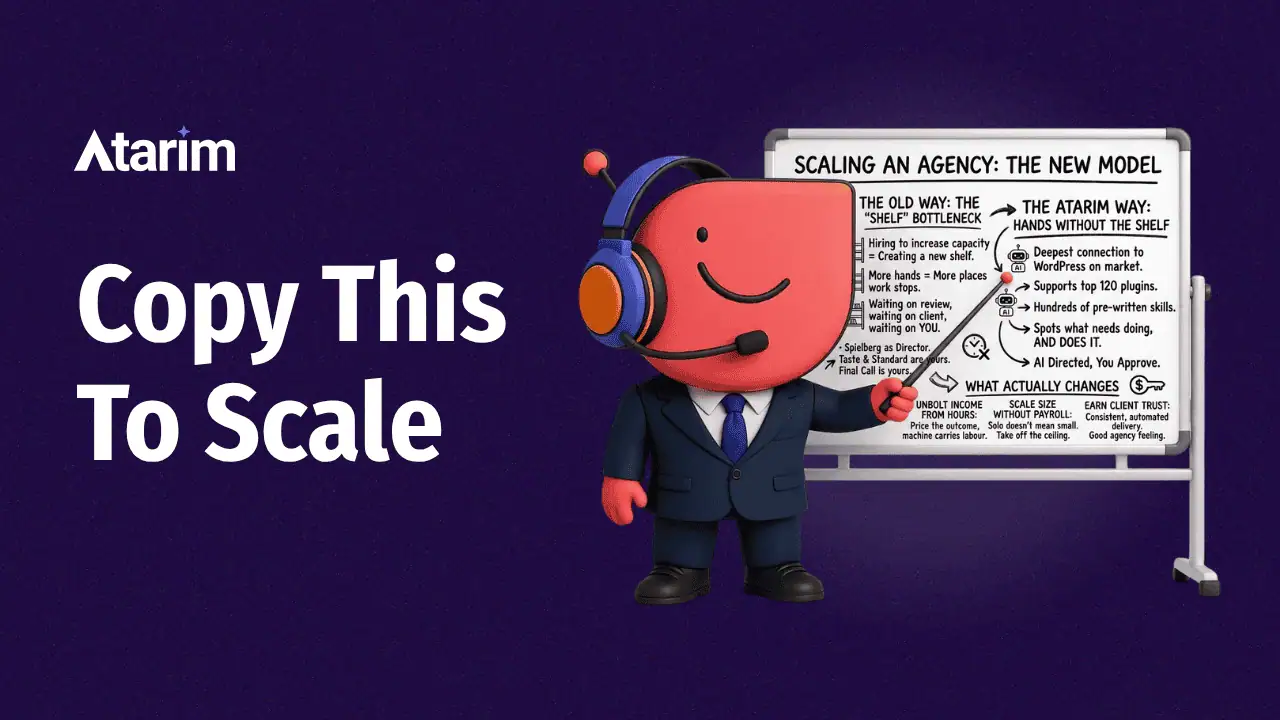
Here’s my answer, and I’d stand on it: you’re the director. The work gets done, you set the standard, and it ships under your name only when you’re happy with it. That was true when the hands belonged to a designer on payroll, and it’s true now.
What the hire also brought
Now, the honest part, because I don’t want to make hiring sound like it solved everything.
That first hire didn’t just bring a payroll. He brought a queue.
Every piece of work now had a moment where it sat, waiting on one of us to pick it back up. He’d finish something and it would wait for my review. I’d send notes and they’d wait for his next free morning. Neither of us was slacking. We were both just mid-something-else, permanently.
And when more people joined, there was more waiting, not less. Every new person is another place work stops.
So the trade was real but it wasn’t free. I bought hands and I paid in delay. Everyone who’s ever grown a small team knows this feeling and mostly assumes it’s a management failure. It isn’t. It’s arithmetic.
What I wanted — what I think most of us wanted — was the hands without the queue.
Hands without the queue
That’s the thing I’ve been building for the last few years, and it’s why Atarim isn’t shaped like a tool with an AI feature bolted on. It’s shaped like a team you direct.
Practically, that means it has to actually know the environment. It has the deepest connection to WordPress on the market, it supports the top 120 plugins, and we’ve written hundreds of skills that teach it to use them the way an agency would — not the way a general-purpose model guesses at them.
That’s the difference between something that can describe what should be done and something that goes and does it. And it’s why people tell me it’s the first plugin they install on a new project, because it’s the thing they need in order to do everything else.
You can also run it through Claude, Codex, or whatever you already use, by installing the Atarim MCP. Same agency, your AI, your workflow, your credits. I’d rather meet you where you work than ask you to move.
What changes when you direct instead of do
Three things, and I’ll be careful here because this is where marketing usually starts making promises it can’t keep.
You stop trading hours. Not automatically — you have to actually change how you quote. But when the labour isn’t yours, pricing the outcome stops being an aspiration you read about in a book and becomes the obvious thing to do. That effective hourly rate I keep going on about — the one that lands around $7.50 to $13 for most agency owners once you count every unpaid hour — that number is a fraction, and this changes the bottom of it.
Your clients trust you more, not less. This surprises people. The fear is that clients will feel fobbed off. What actually happens is that something turns up before they ask, every week, whether or not you were at your desk. That’s the behaviour of an agency that’s paying attention. They don’t experience the mechanism, they experience being looked after.
You get to choose your size. Right now that isn’t really a choice, is it? It’s whatever your hours allow. Growing means hiring, which means management, which means you do less of the thing you’re good at. Staying solo means staying small. Take that ceiling off and both of those stop being true, and you get to pick based on what you actually want your life to look like rather than what the arithmetic permits.
I’m not going to tell you which one to pick. I’ve done both and there’s no correct answer.
The Monday test
Here’s how I’d know if any of this were real, and it’s the test I’d apply to anything claiming to change how you work.
Picture a Monday. You open the laptop and the first draft of the week’s work is already done, waiting on your review.
Same clients. Same standard. Same name on the work.
How does that feel?
If it feels like a relief, you’re a director who’s been stuck doing crew work, and you’ve probably known that for a while.
If it feels like a loss, that’s worth sitting with too, and I don’t mean that dismissively. I felt it on my first hire. The thing you’re mourning is real. It’s just not the thing anyone’s paying you for.
Spielberg didn’t hold the camera. 🤘