
We wanted to find out what human-in-the-loop AI actually looks like on a client’s live page: whether an AI would take on a real change and bring the work back to us before touching anything.
So we picked a small business site with a problem you’ve probably run into yourself. Their contact page didn’t say when people would hear back, so customers would send a message, wait a day, then send another one. A few gave up and called instead.
The fix was one sentence. Any of us could have added it in two minutes, which is what made it a good test.
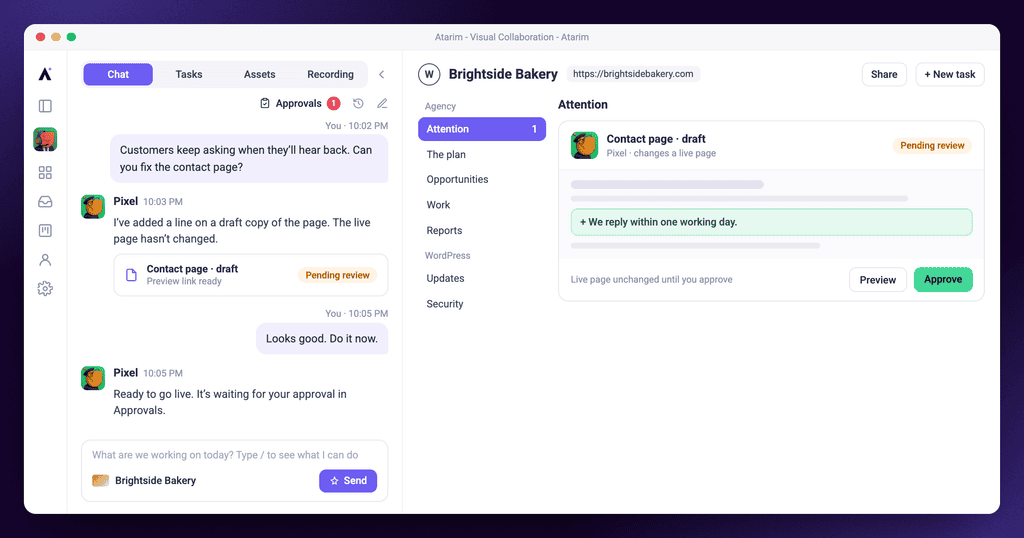
We set it up on a copy of the site and described the problem to Pixel, one of our AI specialists, the same way a client would. We didn’t tell him what to change.
He came back with a proposal. Pixel had:
- Put the line on a draft copy of the page, matched to the grey of the paragraph above
- Noticed the rest of the page was written in the first person, and offered that version too
- Sent a preview link, with the live page untouched
Once we’d picked the version we liked, we replied “do it now”, and the change still waited for one last click from a person before it went live. We approved it, refreshed the page, and the new line was there.
That back-and-forth is what we built Atarim 5.1.4 around.
The rule every agency already has
Every agency I know runs on the same rule, whether it’s written down or not: nobody touches a client’s live site without someone checking first. It was the rule in my agency too, long before AI was part of the picture.
At its core it’s about trust. Your client trusts you with their site, and you keep that trust by making sure a person has seen a change before the client does.
That’s why so many agencies are still holding AI at arm’s length. The thinking goes something like this: if the AI does the work, I’ve given up the check, so I have to choose between speed and control.
I don’t think that’s true, and this whole release is built to prove it wrong.
What human-in-the-loop AI actually protects
The rule has always been about a person saying yes before the client sees anything. Who made the change was never really the point. That’s the idea behind human-in-the-loop (HITL) AI: the AI does the work, but a person reviews and approves it before it takes effect.
For most of this industry’s history, making the change and approving it sat with the same people, because there was nobody else to do the work. Now there is.
When an AI team does the work, the human job gets clearer. You stop being the person who makes the change and become the person who decides on it.
So in 5.1.4, changes to live pages come back as drafts first. Since 5.1.3, new pages from Pixel have arrived as drafts, and now the same goes for changes to pages your client’s visitors are already looking at. Here’s how it works:
- You see the draft and open the preview.
- The task waits in Pending review until you close it.
- Even when you say go, the change still waits for your approval before it lands.
Want to see how this feels on a site you actually manage? Create a free Atarim account and hand Pixel one small change. Nothing goes live until you say so.
An AI that tells you what it measured
The other half of trust is knowing what you’re putting your name on.
We asked Claro, our AI project manager, why another page on the same test site wasn’t showing up in UK searches. He passed it to Index, our SEO specialist.
Before anything else, Index told us which domain he’d measured. He’d used the site’s real domain, so his numbers weren’t coming from the copy we test on. Then he gave us the rankings and suggested a new title, description and heading.
And then he stopped to ask a question. The site never actually says it works with UK clients, so before anyone puts “UK” in the title, someone needs to confirm that’s true.
That pause is the part I care about most. If you’re going to put your name on a piece of work, you need to know what it was based on and where the gaps are.
The same goes for your data. One thing I’ll always say plainly, because people ask: nothing you or your clients put into Atarim is used to train AI models, whether that’s ours or our providers’.
Saying yes from your phone
Once your job is mostly deciding, you don’t need to be at your desk to do it. So 5.1.4 also brings Atarim to your phone. Every main screen has its own small-screen layout, and you can install it like an app, with shortcuts straight to your Inbox and Boards.
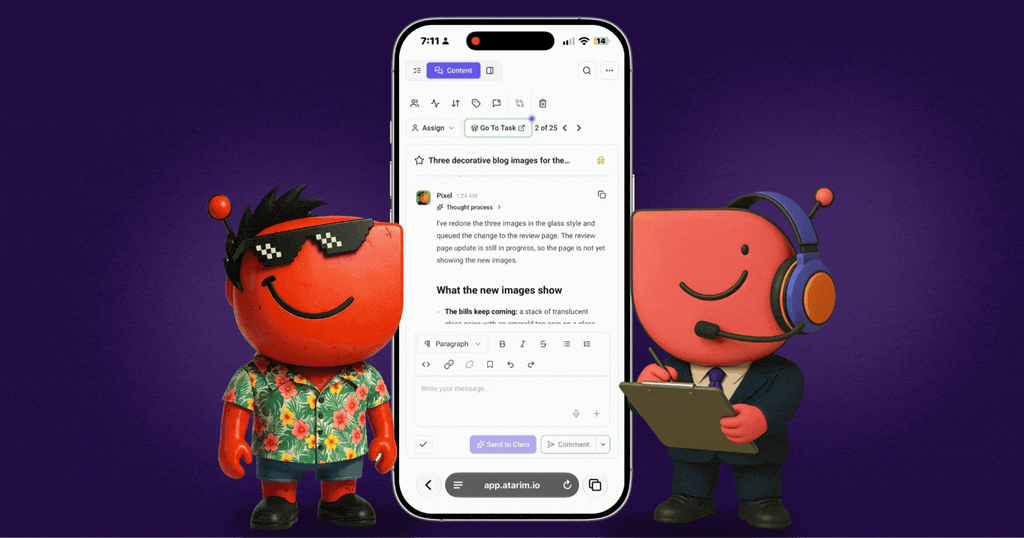
Most client questions don’t wait until you’re sitting down. They show up on the school run or between meetings. Now you can open the task, look at the draft, and say yes from wherever you are.
That’s what “treat every client like they’re your only client” looks like in practice. The work keeps moving while you’re out, and nothing reaches your client that you haven’t seen.
Try it this week
Pick the one change you’d never let anyone push live without seeing it first. Hand it to one of the specialists, describe the problem the way your client would, and see what comes back.
You can start free with Atarim and try it on a real client site.
There’s plenty more in 5.1.4, including:
- Every workflow run shown step by step
- Your logo on every client invitation
- Client reports that take their numbers from verified facts about the site, keep your brand font, and never name Claro or a specialist as the author
- Backups that stay put, because the update round checks the restore point first and never deletes a backup to make room
- Smarter workflow templates, including a weekly opportunity workflow that stops pitching your client work you’ve already offered
- Long email threads that fold their quoted history away in the Inbox, the way your mail app does
It’s all in the changelog at labs.atarim.io/announcements.
And please tell me what you find, the good and the bad. That’s honestly where the next release comes from.
Vito