Best Practices for Client Communication
Three surfaces, three audiences, and one composer that will happily let you send the wrong thing to the wrong person.
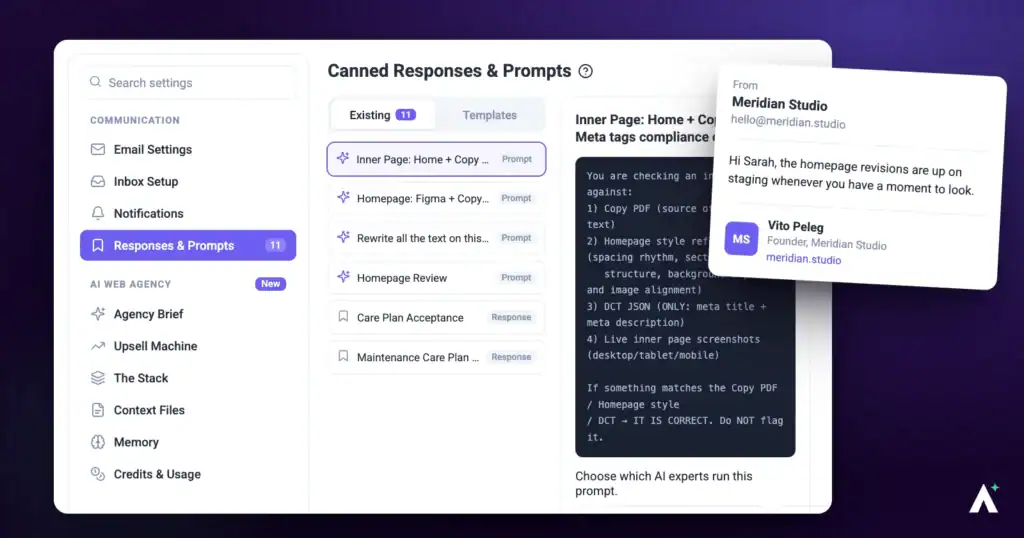
Client communication in Atarim happens across three surfaces: the task feed inside a project, the email inbox, and the simplified guest view your clients see when they open a shared link. Each behaves differently, and the difference matters — a comment your client can read, a note only your team can read, and an email that leaves your workspace entirely are three separate actions that look almost identical in the composer.
Most of the practices below are decisions you make once. Set up your sending identity, agree what your statuses mean, decide which notifications earn a place in a client’s inbox, and save the answers you give every week. The rest is the habit of pausing before you send to ask which of the three things you are actually doing.
Where the Settings Live
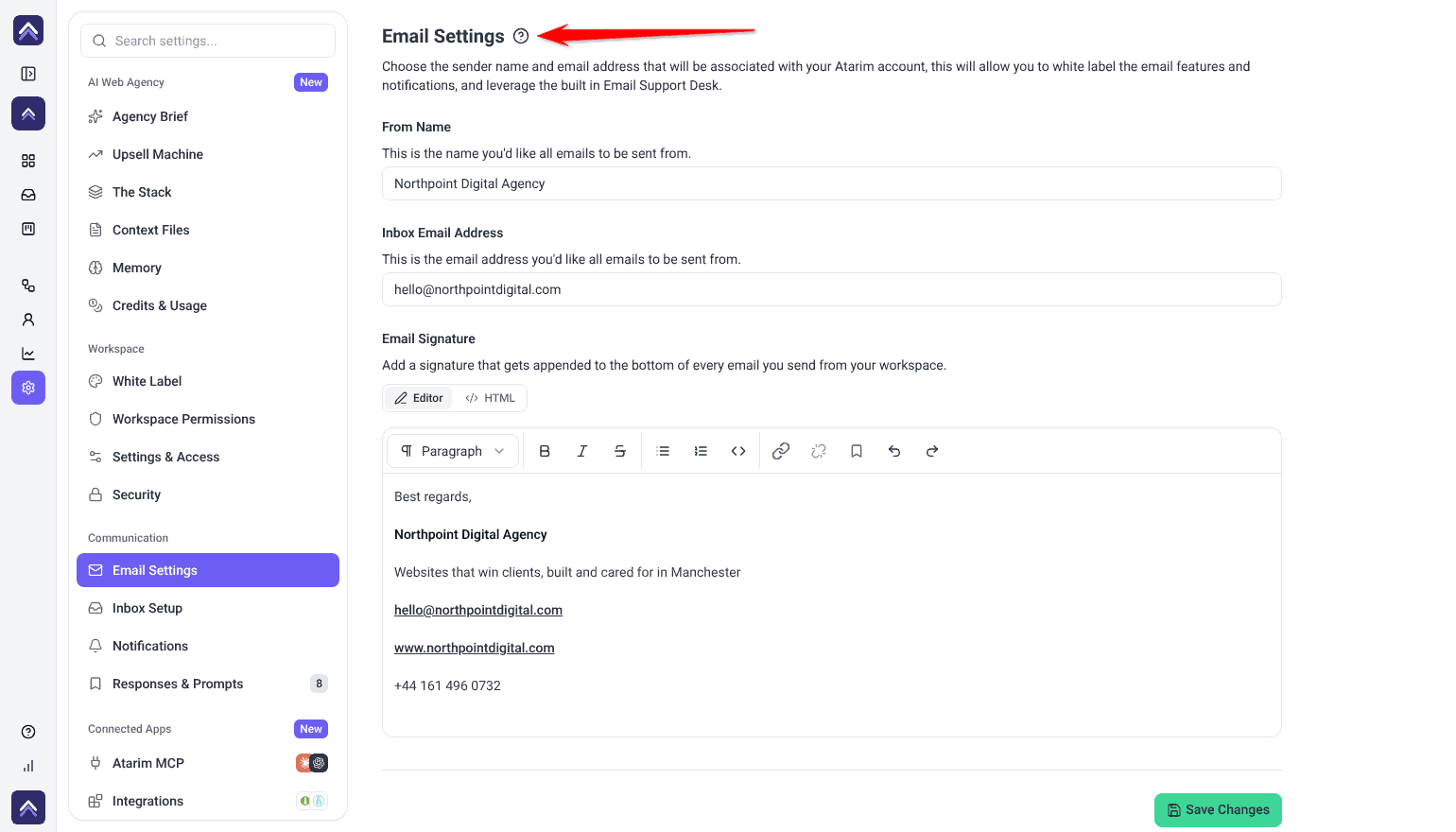
Everything that governs client-facing communication sits in one group. From the main dashboard, select Settings, then find the Communication group in the left sidebar.
| Item | What it controls |
|---|---|
| Email Settings | The sender name, address, and signature applied to outgoing email. |
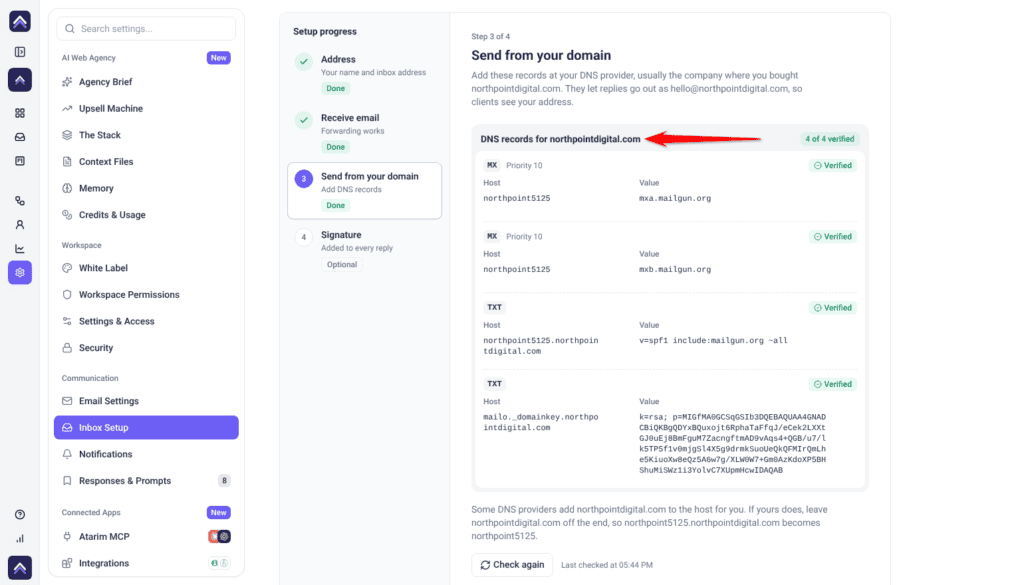
| Inbox Setup | The four-step wizard that verifies forwarding and DNS so Atarim can send on your behalf. |
| Notifications | Which events email your workspace, and who else receives a copy. |
| Responses & Prompts | Your saved canned responses, with a badge showing how many you have. |
The per-task controls — comments, private notes, internal tasks, and canned response insertion — live in the task feed itself, not in Settings.
Set Up Your Sending Identity Before You Email Anyone
This is the highest-value thing to do first, and the easiest to skip. Until your workspace mailbox is verified, Atarim sends from its own default address rather than yours. Clients see an unfamiliar sender, and no amount of signature editing fixes it afterwards.
Instructions:
- From the main dashboard, select Settings.
- In the Communication group, select Email Settings.
- In From Name, enter the name you want all emails to be sent from.
- In Inbox Email Address, enter the address you want all emails to be sent from. The field validates when you click away from it.
- In Email Signature, write the signature to append to every email sent from your workspace. To paste a signature you already have as code, switch from Editor to HTML first. A preview, How a reply will look, shows the result.
- Select Save Changes.
Completing Inbox Setup
Select Inbox Setup from the Communication group. This opens a four-step wizard: Address, Receive email, Send from your domain and Signature, which is optional.
Instructions:
- On Your inbox address, enter a From name and your Inbox address, then select Continue. The name must be at least two characters.
- On Receive email, copy Your forwarding address. Under Set up forwarding in your email provider, pick your provider and follow the steps to forward your real address to it.
- Select Send test email. Atarim keeps checking for 5 minutes. When you see Forwarding works, select Continue.
- On Send from your domain, copy the MX, SPF and DKIM records into your DNS settings. Each Host and Value has a copy button, and each record shows Verified, Waiting or Not found yet. With a free email address such as Gmail, this step is skipped.
- On Signature, write the signature added to every reply you send, then select Save signature, or Skip.
- The summary shows where each part stands. Select Go to your inbox. To change anything later, open Inbox Setup again.
Know Which of the Three Actions You Are Taking
Inside a task, the composer can produce three different outcomes depending on which control you use. Getting this wrong is the most common way a client sees something they should not have.
| Action | Who can see it | Does it email anyone? |
|---|---|---|
| Comment | Everyone with access to the task, clients and guests included. | Yes — notified users receive a new-comment email if that notification is on. |
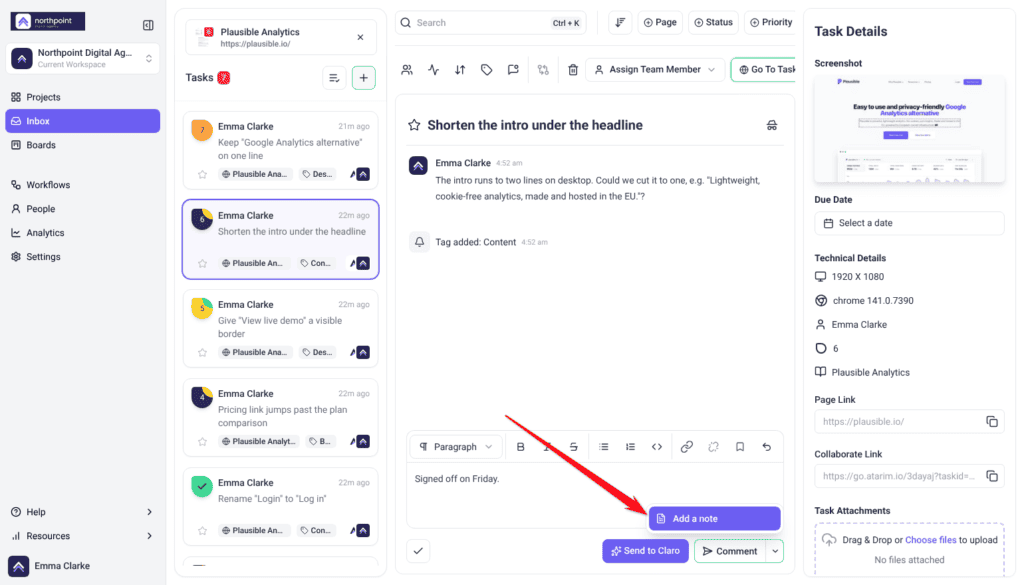
| Private note | The project owner, Administrators, and Team Members only. | No — notes never trigger notification emails. |
| Whoever you enter in To, Cc, and Bcc. | Yes — it leaves your workspace as a real email. |
Leaving a Private Note
A private note stays on the task but never reaches the client, which is the whole difference between it and a comment.
Instructions:
- Open the task and type your message into the composer.
- Open the menu on the Comment button and choose Add a note, then select Add a note to post it. On a design, select the note icon beside the send button instead.
- The note posts to the feed. A confirmation reads Note added successfully.
Sending an Email
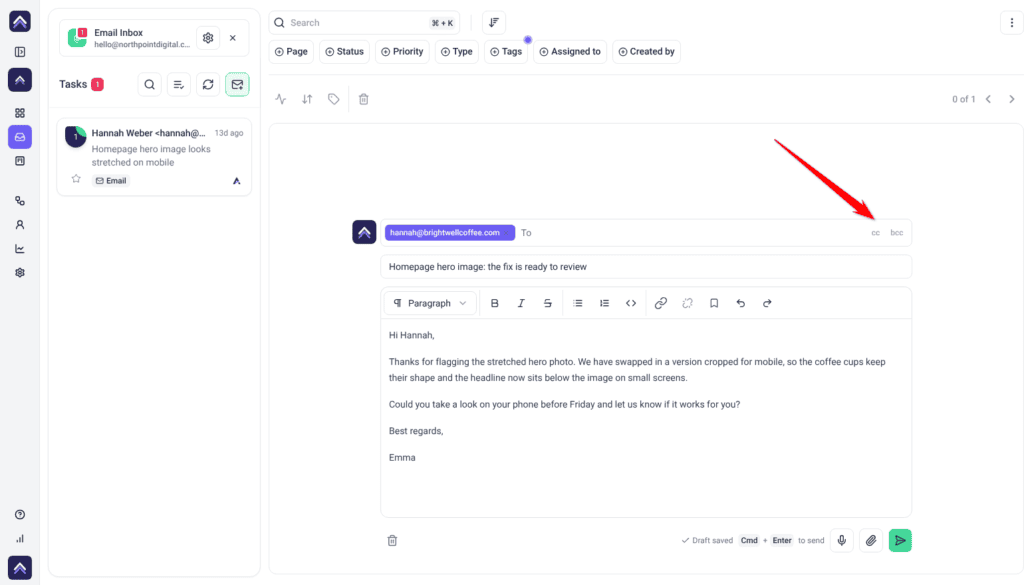
In an email project the composer switches to an email editor with To and optional Cc and Bcc rows, plus a Subject row when you start a new email. Replies don’t have a Subject row. The cc and bcc controls sit inside the To field on the right. The composer saves a draft as you type and shows Draft saved. To throw a draft away, select the bin icon, Discard draft.
Instructions:
- Add recipients to To, and reveal Cc or Bcc if you need them. Hiding a row again clears whatever was in it, and invalid addresses are removed as you add them.
- For a new email, enter a Subject.
- Write the message. Attach files with the paperclip control if needed — pending attachments are listed below the composer and each can be removed before you send.
- Select the send control, or press Ctrl + Enter (Cmd + Enter on a Mac). Enter on its own adds a new line. Sending without a recipient is refused with Please enter at least one recipient email address.
Handling emailed requests day to day
Once Inbox Setup is finished, client emails you forward or CC to Atarim arrive as tasks. Forwarding and moving an email into a project are covered in Method 9: By Forwarding an Email, and the DNS records in Adding DNS Records to Verify Your Domain.
- Where they land. Each new email becomes an email task in the Email Inbox, which is listed like a project in the Inbox project picker. If the sender already collaborates on exactly one of your projects, the task is filed under that project instead.
- Anyone on the team can work it. Owners, Administrators and Team Members can change an email task’s status, priority and tags, and assign it to a project, not only the person who set up the Inbox. Email tasks have no assignee.
- Replies stay together. A reply to an email that is already in Atarim is added to the original email’s task, rather than opening a new one.
- Quoted history is folded away. Earlier messages quoted inside an email are hidden behind a ••• button. Select it (its tooltip reads Show quoted text) to show them.
- Starting a new email. In Inbox, pick Email Inbox in the project picker, then select the compose button at the top of the task list (its tooltip reads Compose email). It stays greyed out until the inbox is verified. An empty inbox shows a Compose Email button instead. The composer then works as described above.
Hide Work in Progress Instead of Explaining It
Some tasks should never reach the client’s view at all — internal QA passes, technical debt, notes to self created during a review. Marking a task internal removes it from the guest and client experience rather than making you phrase around it. Open the task and select the internal control at the top of the task. In the Inbox it sits in the task header, and its tooltip reads Hide this task from guests & clients. Select it again to reverse.
Standardise Your Replies with Canned Responses
If your team answers the same five questions every week, saved responses stop the answers drifting — and let a newer team member reply in the voice the agency already uses.
Instructions:
- From the main dashboard, select Settings, then Responses & Prompts.
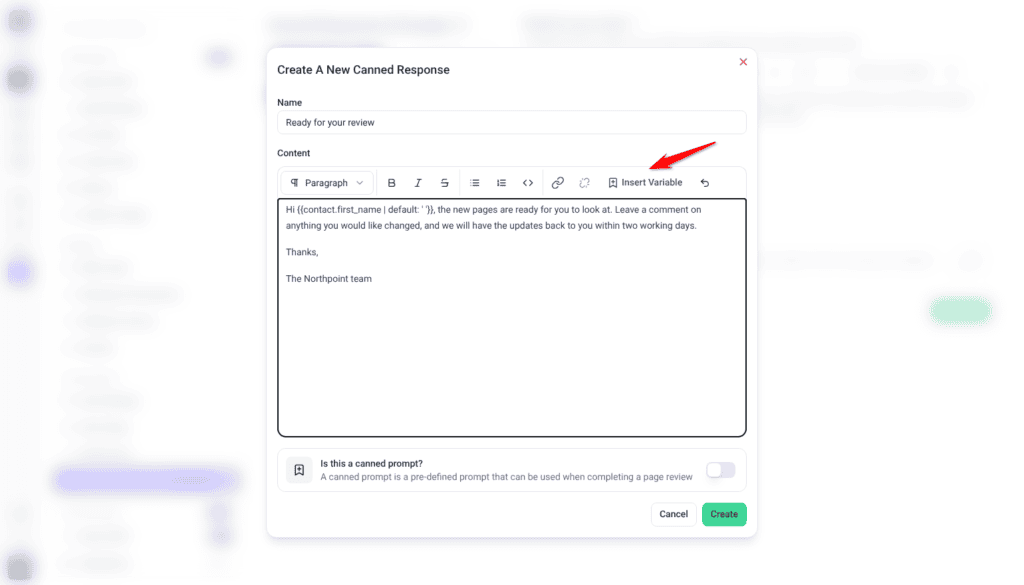
- Select Add a Canned Response at the end of the list. The modal is titled Create A New Canned Response.
- Enter a Name. The create button stays disabled until this field has content. Add your content too, because a canned response needs both a name and content before it saves.
- Write the message in Content, using Insert Variable for merge fields.
- Leave Is this a canned prompt? switched off — that converts the entry into an AI prompt used during page reviews, and prompts do not appear in the reply picker.
- Select Create.
To use one, open the task or email, select the bookmark control in the editor toolbar, choose a template from the searchable list, read the preview on the right, and select Use Template. The content is inserted where you can edit it before sending.
| Variable | What it inserts |
|---|---|
| Contact’s First Name | The first name of the sender email address. |
| The contact’s email address, from the email thread the task came from. | |
| Urgency | The urgency of the current task. |
| Status | The status of the current task. |
Tune Notifications So Clients Are Informed, Not Buried
Select Notifications from the Communication group. This panel sets the defaults for the whole workspace. Each person can also choose which emails they get about tasks assigned to them, under Assigned Tasks Notifications in their profile. Six notification types are available, and all six are on by default.
| Notification | Worth keeping on for clients? |
|---|---|
| Every new task | Usually yes — it confirms their request landed. |
| Every new comment | Yes. This is the one clients act on. |
| When a task is marked as complete | Yes. Completion is the update they are waiting for. |
| Every status change | Often the first to turn off on a busy project. |
| Last 24 hours report | Rarely wanted by clients. |
| Last 7 days report | Rarely wanted by clients either. |
Above the list, Additional recipients sends a copy of every notification to addresses you specify, on top of the workspace users. Separate multiple addresses with a comma. The panel autosaves — there is no Save button.
Choose the Right Level of Client Access
How a client reaches a project shapes how they communicate in it. Open a project and use the share control to reach the sharing modal, titled Collaborate on this project. It has three tabs: Team Members, Guests and Clients, and Manage Access — the last visible only to Administrators.
Instructions:
- Open the sharing modal and select the Guests and Clients tab.
- Under Add Guests or Clients, type an email address and press Enter to add it. Repeat as needed.
- Under Add a Note, provide some context for the invite.
- Select Instant Invite – No Login Needed. Guests invited this way are scoped to that project only, and see a simplified interface built for non-technical users.
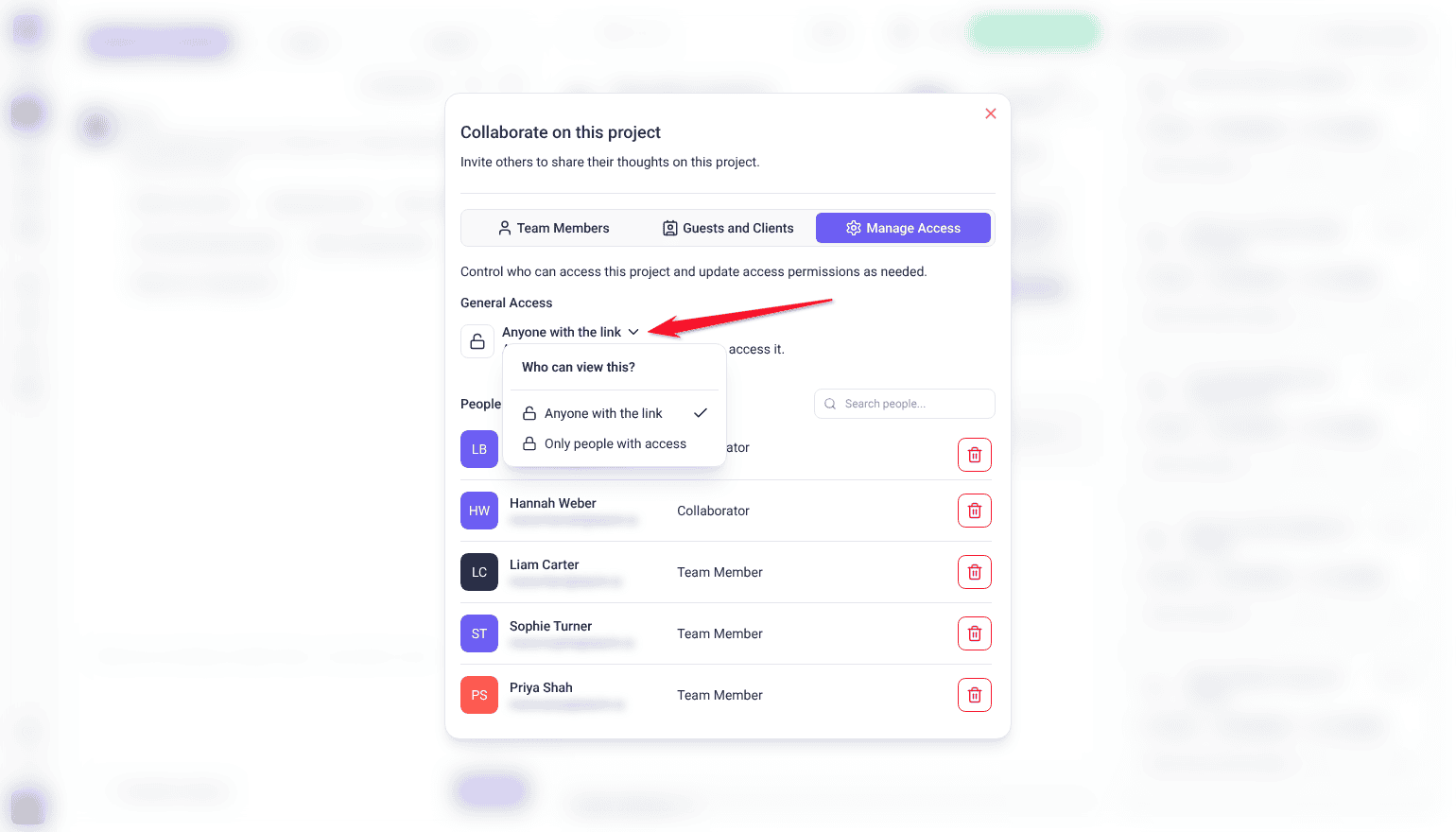
| General Access option | What it means |
|---|---|
| Anyone with the link | Anyone with the link to the project can access it. |
| Only people with access | Only people invited to the project can access it. |
The same tab carries Enable Guest Mode, which launches Atarim in Comment Mode for guests by default, and People with Access, a searchable table of everyone currently on the project.
On WordPress Sites with the Plugin Connected
If the project is a WordPress site running the Atarim plugin, there is a second layer of control in the WordPress admin at Settings → Collaborate.
- Who can collaborate selects which WordPress user roles see the collaboration interface. Only those roles see it unless Guest Mode is switched on.
- Three routes bring people in: copy and share a quick link, add
?collab=trueto any link on the website, or turn on Guest Mode via the Manage Access tab. - Select Save & Apply to store changes.
Keep Status and Priority Meaningful
Status and priority are communication, not bookkeeping. A client watching a board reads them as a promise. Both use fixed sets of four.
Benefits of Communicating Consistently
| Benefit | In practice |
|---|---|
| Emails look like yours | A verified mailbox means clients recognise the sender instead of querying it. |
| Nothing leaks by accident | Notes and internal tasks give internal conversation a home that is not the client’s feed. |
| Replies stay on message | Canned responses keep the same answer coming from everyone on the team. |
| Notifications keep their meaning | Fewer, better-chosen emails are the ones clients still open in month six. |
| History stays in one place | Replying on the channel the client used keeps the thread readable later. |
Example Use Cases
| Situation | What to do |
|---|---|
| A client request is out of scope | Note the concern internally first, agree a position, then comment once with the answer. |
| Internal QA before a review round | Mark the QA tasks internal so the client’s view shows only their own feedback. |
| The same onboarding question every week | Save it as a canned response and insert it from the picker. |
| A client complains about email volume | Turn off status-change notification for the workspace, keep comment and completion. |
| A one-off review with a stakeholder | Invite them from Guests and Clients with a note explaining what you need. |
| Handing a project to a new team member | Point them at the notes on each task — the reasoning is already written down. |
Known Limitations
- Internal tasks silence your own team too. Suppression is total, not client-only.
- There is no per-client notification profile.
- Merge variables depend on email history. Contact variables do not resolve on tasks created outside the inbox.
- Verification can take time. Emails sent before it completes cannot be retroactively rebranded.
- Some controls are plan-dependent — notes, internal tasks, canned responses, the email signature, and additional recipients each show a plan badge when unavailable.
FAQs
Can my client see private notes?
No. Notes are visible only to the project owner, Administrators, and Team Members. Guests, clients, and collaborators never see them.
Do notes send email notifications?
No. Notes are excluded from notification email entirely, which is part of why they suit sensitive detail.
Why is my team not getting emails about an internal task?
Marking a task internal suppresses all notifications for it, not only the client-facing ones. Track internal tasks from the dashboard instead.
Can I turn off a notification just for myself?
Partly. Each person can choose which emails they get about tasks assigned to them, under Assigned Tasks Notifications in their profile.
Do I need DNS access to send email from Atarim?
You need it to add the MX, SPF, and DKIM records shown in Send from your domain. Until they verify, replies go from Atarim’s sending address, with your address as the reply address.
Do clients need an Atarim account?
No. Instant Invite – No Login Needed gives them access to that one project with no sign-up.
Can I reuse one canned response across tasks and emails?
Yes, the picker is available in both. Avoid contact variables in responses you reuse that way, since they only resolve on tasks with email history.
What is the difference between a canned response and a canned prompt?
A response is text you insert into a reply. A prompt is used by AI during a page review, and does not appear in the reply picker.
Common issues
- Emails arrive from an Atarim address, not yours — your DNS records have not verified yet. Open Send from your domain in Inbox Setup and select Check again.
- The test email never arrives — Atarim checks for 5 minutes after you select Send test email. Confirm forwarding points at Your forwarding address, then select Send the test email again.
- A DNS record shows Waiting or Not found yet — it has not propagated or was pasted incorrectly. Re-copy it with the copy button beside it and check it at your DNS provider. DNS changes can take up to 48 hours.
- A client saw something meant for the team — it was posted as a comment. Use Add a note for internal remarks, and mark whole tasks internal when nothing in them is client-visible.
- Nobody is getting notifications for a task — check whether the task is internal. That suppresses all notifications, including to your own team.
- A merge variable appeared as raw text — re-add it using Insert Variable so it is written in the form Atarim expects.
- Contact’s First Name resolved to nothing — the task has no attached email correspondence, so the variable fell back to its default value.
- An item is missing from Communication — Email Settings, Notifications, and Responses & Prompts are permission-gated. Ask an Administrator to check your role.
- A control shows a plan badge — the feature is not on the current plan. The badge names the minimum plan, and only the workspace owner can change the subscription.
- A guest cannot open the link you sent — check General Access on Manage Access. If it is Only people with access, the person must be invited individually.
Conclusion
Good client communication in Atarim is mostly a matter of deciding things once. Verify your sending identity so every email carries your agency’s name. Agree what your statuses mean. Decide which notifications earn a place in a client’s inbox and switch off the rest. Save the answers you give repeatedly so they stay consistent.
Then build the one habit that protects all of it: before you send, ask whether this is a comment, a note, or an email. The product will let you pick the wrong one without complaint.
Tips & best practices
- Verify your mailbox before your first client email, not after — earlier sends cannot be rebranded.
- Default to a note when you are unsure. A note can be repeated to the client later; a comment cannot be unread.
- Read the canned response preview before inserting. Variables resolve there, so it is an honest check.
- Turn off status-change email on long projects, and keep new comment and completion.
- Mark internal work internal at creation rather than hiding it after a client has seen it.
- Write a note on every guest invite. Context is what stops it reading like spam.
- Reply on the channel the client used, so the thread stays in one place.