Deleting Projects: How to Manage Dormant or Completed Projects
When to delete, when to archive instead, and exactly what happens when you do.

Deleting a project removes it and all its tasks and activity from your dashboard permanently. Atarim states it plainly in the dialog, and the wording is worth taking at face value: this action cannot be undone.
That makes the interesting question not “how do I delete a project” but “should I”. Most of the time the answer is no.
Archive First, Delete Rarely
Both actions free a project slot on your plan. Only one of them is reversible, which makes archiving the right default for anything you are not certain about.
| Archiving | Deleting | |
|---|---|---|
| Tasks and comments | Kept in full | Removed permanently |
| Reversible | Yes, in two clicks | No |
| Frees a project slot | Yes | Yes |
| Client history | Retained for future reference | Gone |
| Confirmation | A single confirmation | Typing a generated number |
Why Archiving Is Usually the Better Answer
Archiving is not a weaker version of deleting. It solves the same practical problems — a cluttered screen, a full plan — while keeping everything that makes a returning client easy to pick back up.
| Benefit of archiving | In practice |
|---|---|
| It frees the same project slot | If your only reason for deleting is a full plan, archiving solves it identically — and costs nothing to reverse. |
| Nothing is lost | Tasks, comments, attachments, and the whole client conversation stay exactly as they were. |
| Restoring takes two clicks | A project comes back from Archived Projects with its history intact, so a wrong call is not a permanent one. |
| Returning clients are easy | When a client comes back eighteen months later, the record of what was agreed and why is still there. |
| The decision stops being risky | Archiving turns “should I remove this?” into a low-stakes question, so tidying actually gets done. |
Archiving frees the project slot without losing anything, which is what makes it the safer default.
Instructions:
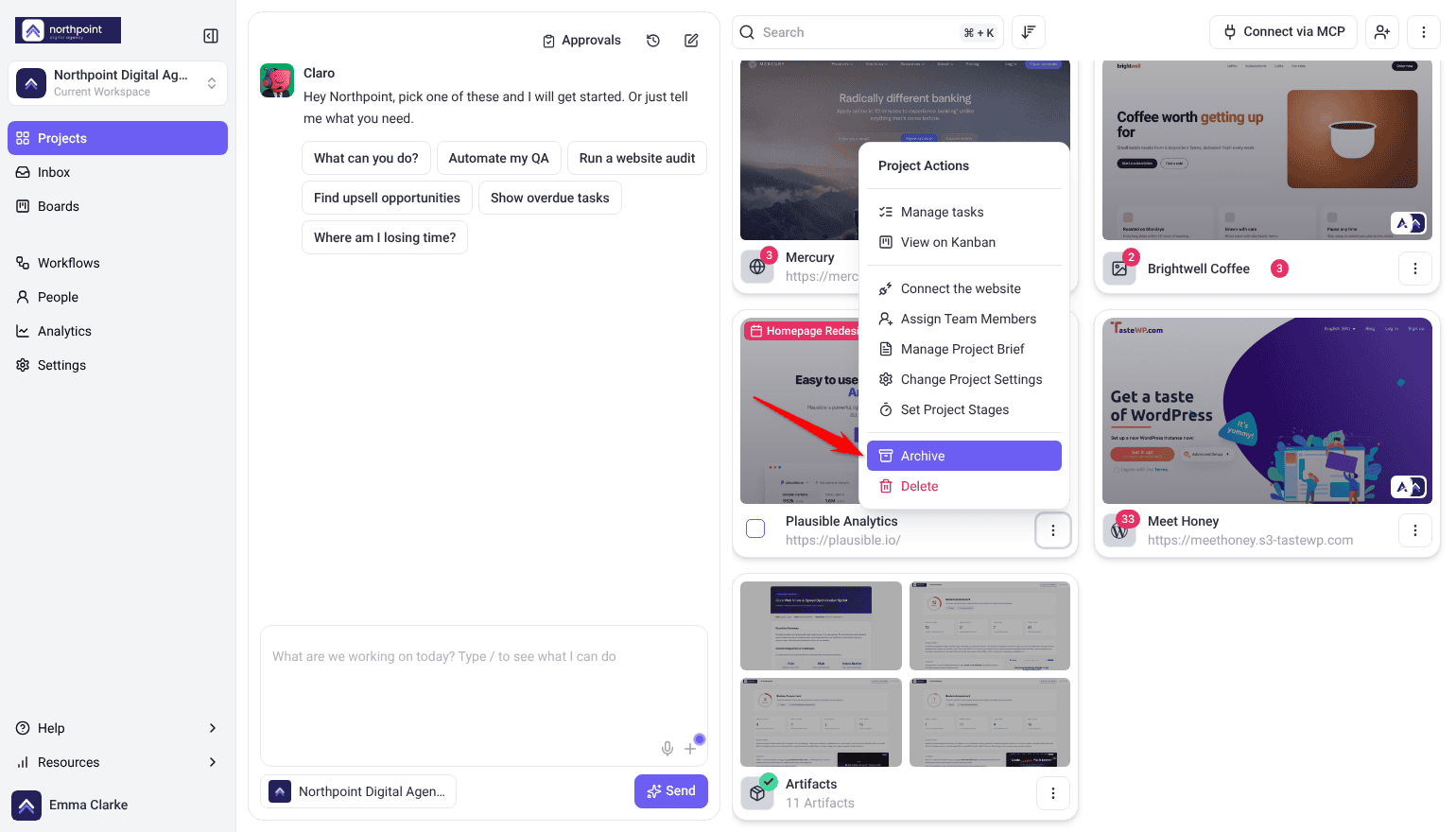
- Open the project’s kebab menu, the three vertical dots.
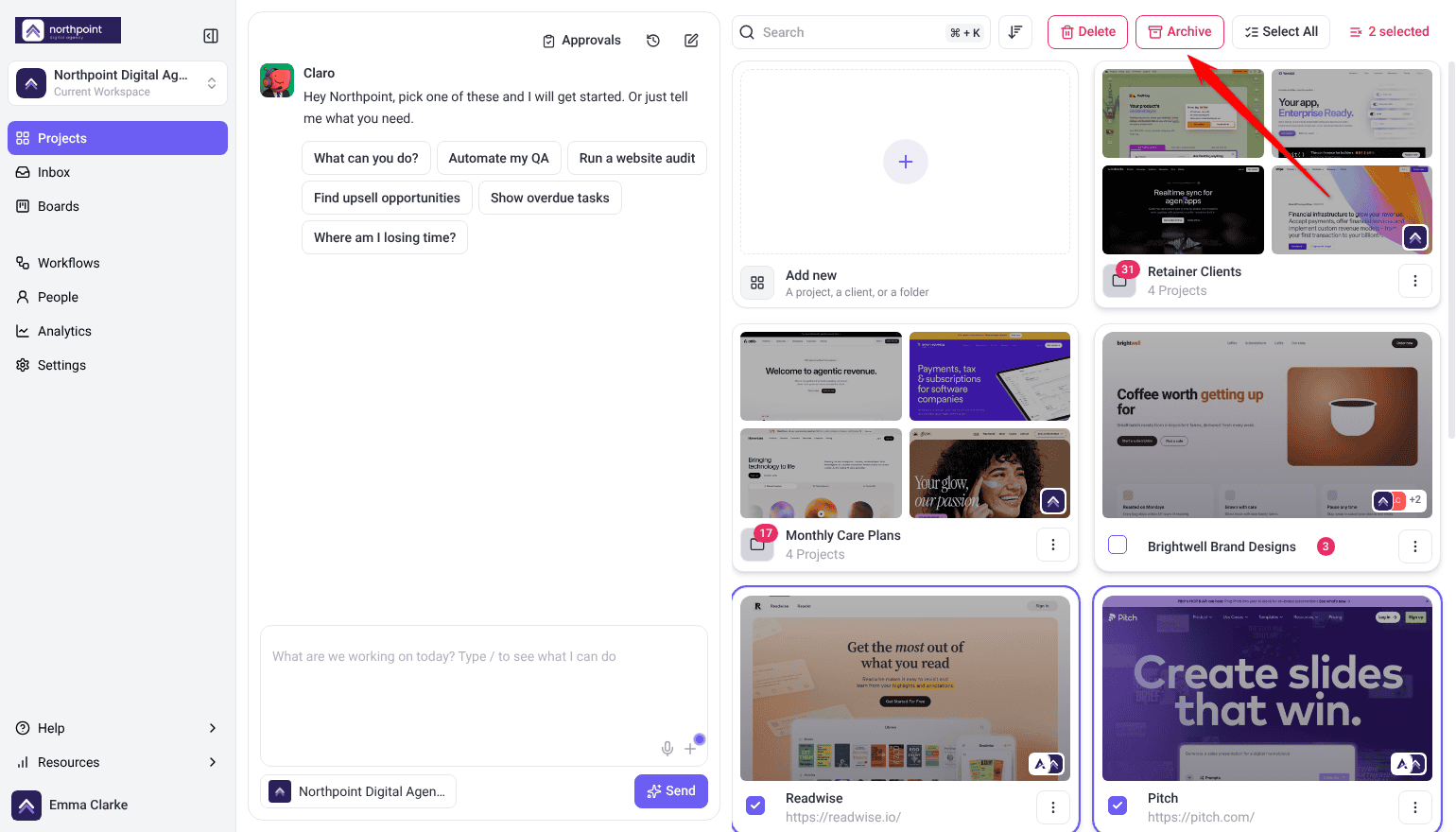
- Select Archive rather than Delete. Alternatively, bulk-select projects and choose Archive in the top bar.
- To reach archived projects later, open Archived Projects from the top-right kebab menu on the Projects screen.
When Deleting Is the Right Call
There are genuine reasons to delete. They are narrower than most people assume.
| Situation | Delete? |
|---|---|
| A project created by mistake, or a duplicate | Yes — there is no history worth keeping. |
| A test or demo project | Yes, once it has served its purpose. |
| A client has asked you to remove their data | Yes — this is what deletion is for. |
| A completed client project | No. Archive it — clients come back, and the history is the record. |
| You have hit your project limit | No. Archiving frees the same slot without losing anything. |
| A dormant project you might revive | No. That is precisely what archiving is for. |
What Deletion Removes
Worth being clear on the scope before you confirm, because it goes further than the project card.
| What | Outcome |
|---|---|
| The project | Removed from your dashboard permanently. |
| Its tasks | Removed, including anything still open. |
| Comments and feedback | Removed, including your client’s own words. |
| Its activity | Removed from your dashboard. |
| Your project slot | Released back to your plan. |
| The website itself | Its content is untouched. Deleting a project in Atarim does not change the live site’s content. |
Deleting a Project
The confirmation is deliberately awkward. Atarim generates a random four-digit number and asks you to type it before the project is deleted, which makes an accidental deletion much less likely.
Instructions:
- Go to Projects and find the project.
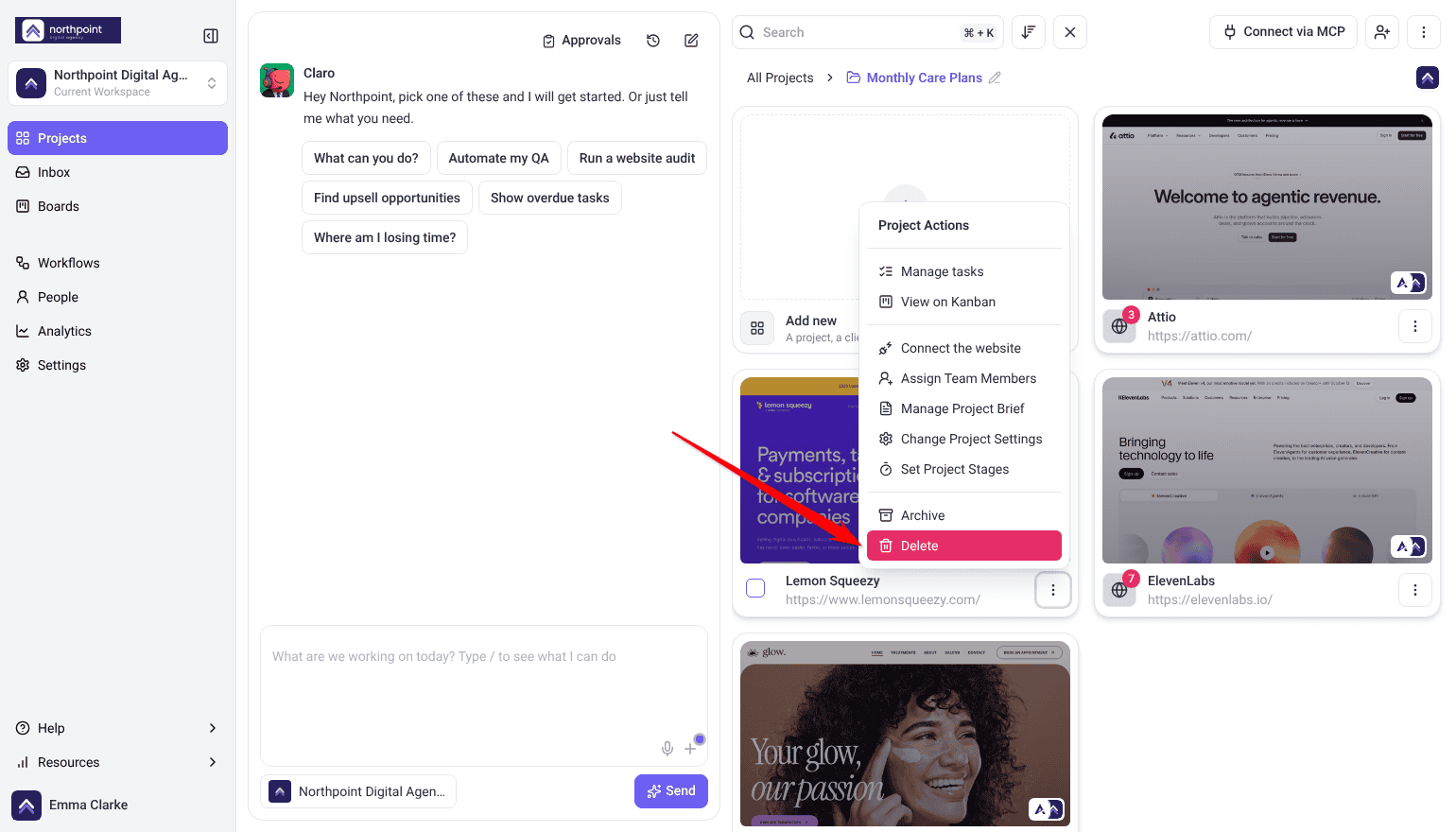
- Open its Project Actions menu and select Delete. A dialog opens warning that deleting removes the project and all its tasks and activity permanently, and that the action cannot be undone.
- Check the project named in the dialog is the one you mean.
- Read the four-digit number shown in bold. It is generated fresh each time, so it cannot be muscle-memoried.
- Type that number into the field below it. The confirm button stays disabled until it matches exactly.
- Select Delete Project to confirm, or Cancel to back out.
Deleting Several Projects at Once
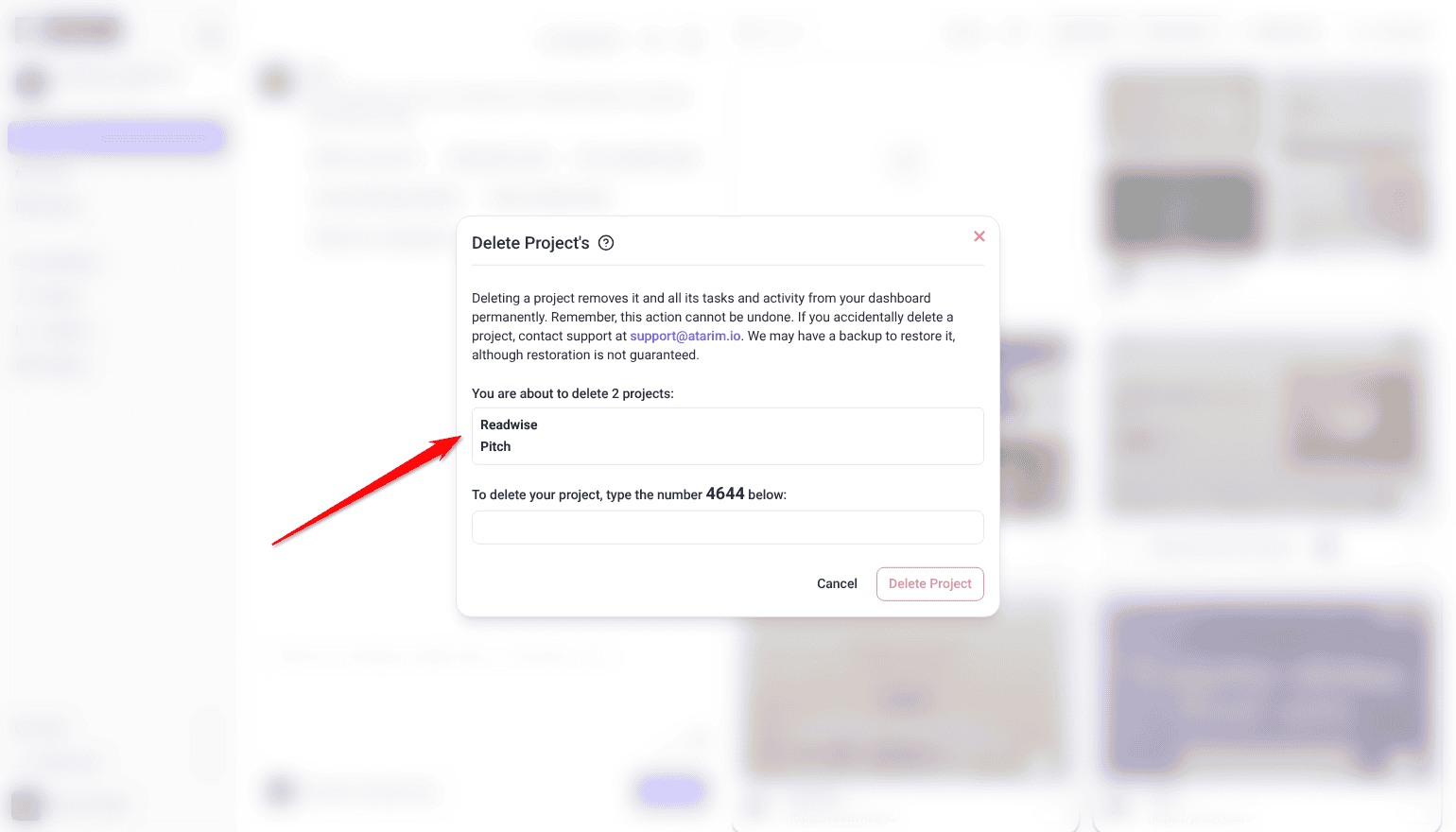
The same dialog handles a batch, and it lists every project by name so you can check the selection before committing to it.
Instructions:
- On the Projects screen, hover a project card to reveal its checkbox.
- Select every project you intend to delete.
- Select Delete in the bar at the top of the screen. The dialog states how many projects are about to be deleted, followed by the full list of names.
- Read the list. This is the only point at which a wrong selection is visible — every name shown is about to be removed permanently.
- Type the four-digit number and confirm.
Deleting a Folder
Folders behave differently, and this is where the real risk sits. Deleting a folder does not have to delete its projects — but the dialog offers to, and the options are easy to tick past.
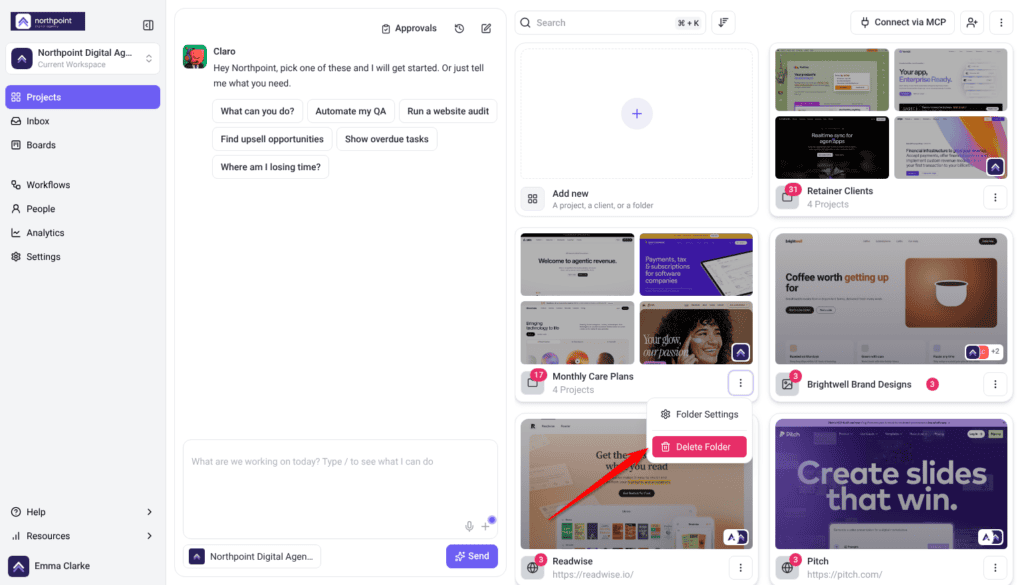
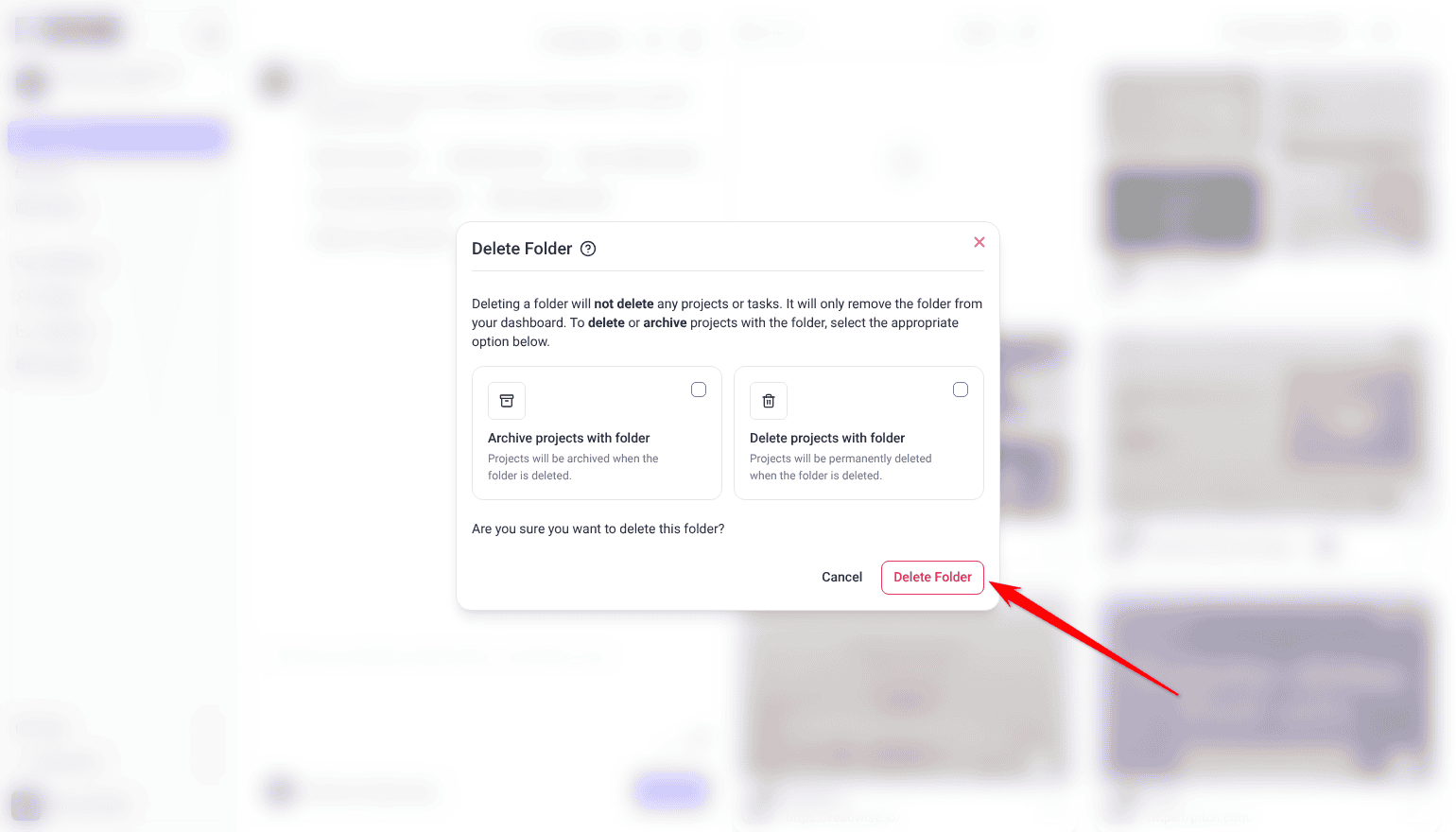
- Open the folder’s ⋮ menu and select Delete Folder. The dialog asks whether you are sure, with two options beneath.
- Decide what happens to the projects inside. Archive projects with folder archives them; Delete projects with folder removes them permanently. Leave both unticked and the projects simply return to your main Projects view.
- Read the confirmation line. It changes to match your choice, so the consequence is spelled out before you confirm.
- Select Delete Folder to confirm.
If You Delete Something by Mistake
The dialog names a route, and it is worth knowing before you need it — but it is a hope rather than a guarantee.
Instructions:
- Contact support immediately at support@atarim.io. Atarim’s own wording is that they may have a backup to restore it, although restoration is not guaranteed.
- Include the project name and roughly when it was deleted. The more precise you are, the better the chance of finding it.
- Do not wait. Speed matters, because backups do not last indefinitely.
Benefits of Managing Dormant Projects Well
| Benefit | In practice |
|---|---|
| A Projects screen you can scan | Finished work is out of the way, so the list shows what is actually live. |
| Slots go further | Clearing dormant work is nearly always cheaper than upgrading a plan. |
| Client history survives | Archiving keeps the record of what was agreed and why, for whenever they come back. |
| Genuine data removal when it is asked for | Deletion exists for the cases where a client wants their data gone. |
| Fewer regrets | A habit of archiving means a wrong decision is two clicks from being reversed. |
Example Use Cases
| Situation | What to do |
|---|---|
| You added a site to the wrong workspace | Delete it and add it again in the right one — there is no history to lose. |
| A client relationship has ended | Archive. If they later ask for their data to be removed, delete it then. |
| A demo project from a sales call | Delete once it is no longer needed. |
| Annual clear-out | Sort by Oldest Projects First, select the finished work, and archive it in one action. |
| Winding up a client folder | Archive the projects with the folder rather than deleting them, unless the client has asked otherwise. |
| A duplicate created by accident | Delete the duplicate, keeping the one with the feedback on it. |
Known Limitations
- Deletion cannot be undone from the dashboard. Support may hold a backup, but restoration is not guaranteed.
- Deleting a project removes its tasks, comments, and activity along with it.
- Deleting a folder can delete every project inside it if that option is ticked.
- Deletion is permission-based, so the option may not appear for every role.
- There is no bin or recovery area in the dashboard — unlike archiving, which has its own screen.
- One confirmation covers a whole batch. Deleting twenty projects is no harder than deleting one, so the list of names is the only safeguard.
FAQs
Can I undo a deletion?
Not from your dashboard. Contact support@atarim.io as soon as you can — a backup may exist, though restoration is not guaranteed.
Why do I have to type a number?
To make an accidental deletion much less likely. The number is generated fresh each time, so the step cannot become automatic.
Does deleting a project affect my live website?
No. Your site’s content is untouched. If the site uses the WordPress plugin, collaboration is switched off in the plugin, but the plugin stays installed.
Should I delete or archive a finished client project?
Archive. Both free a project slot, but archiving keeps the tasks and client conversations in case the client returns.
Does deleting a folder delete its projects?
Only if you tick that option. Left unticked, the projects return to your main Projects view.
Is there a bin I can recover from?
No. Archived projects have their own screen; deleted ones are gone.
Can I delete several projects at once?
Yes. Select them on the Projects screen, then select Delete in the bar at the top of the screen. The dialog names every project in the batch and asks for one confirmation number, so read the list carefully.
Is bulk archiving available too?
Yes, and it is the better option for a clear-out — it frees the same slots and a wrong selection can be undone.
Common issues
- The confirm button stays disabled — the number must match exactly. Check you are reading the current one; it regenerates each time the dialog opens.
- Delete is missing from the actions menu — your role does not include it. Team Members don’t have it by default, and it isn’t set in Settings → Workspace Permissions, so ask an administrator about your role.
- A project vanished and you did not delete it — check Archived Projects first, then your workspace and filters. Archiving is far more common than deletion.
- You deleted a folder and its projects went too — the delete option was ticked. Contact support quickly; there may be a backup.
- You deleted more than you meant to — the dialog lists every project in a batch before confirming. Contact support immediately with the names.
- You want the project back — email support@atarim.io as soon as possible with the name and approximate date.
- You only wanted to free a slot — archiving does that too, and keeps everything. Use it next time.
Conclusion
Deletion exists for mistakes, duplicates, and genuine data-removal requests. For everything else — finished work, dormant accounts, a full project list — archiving does the same job for your dashboard while keeping the history that makes a returning client easy to pick back up.
Tips & best practices
- Archive by default. Delete only for mistakes, duplicates, and data-removal requests.
- Treat the four-digit number as a moment to reconsider, not an obstacle to get past.
- Read the folder checkboxes every time — they decide whether the projects inside survive.
- Never plan around support being able to restore something. Archive anything you might want back.
- Do an annual clear-out by sorting oldest first and archiving in bulk — not deleting in bulk.
- Read the list of names in a batch deletion. One number confirms the lot.
- If a client asks for their data to be removed, delete — that is what it is for.