Jira
Push tasks to Jira, pull them back, and keep client feedback flowing into the backlog your developers already work from.
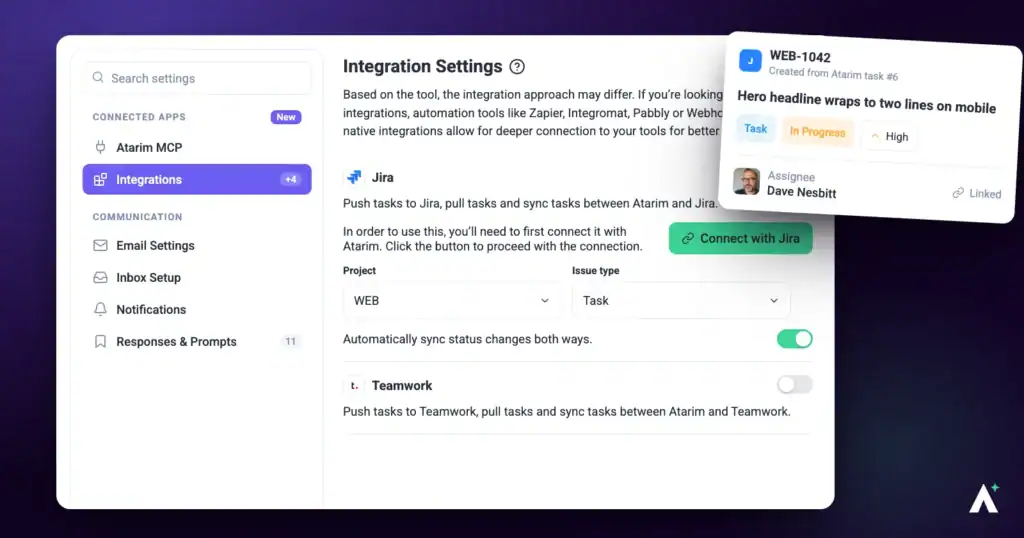
Client feedback captured visually in Atarim becomes an issue in the Jira project your developers already plan from. Setup has two parts: connect your Jira account, then choose the Atlassian site and the Jira project your workspace’s tasks feed. Automatic sync uses one Jira project per workspace.
One Jira project receives the tasks from your Atarim workspace.
The Jira integration lets you push tasks to Jira and pull tasks back, with each task’s details carried across.
Connect Jira
The connection belongs to the Atarim workspace you are in. If you use more than one workspace, connect Jira in each one. The Atlassian site and Jira project are chosen separately, below.
Instructions:
- In Atarim, go to Settings.
- Under Connected Apps, select Integrations.
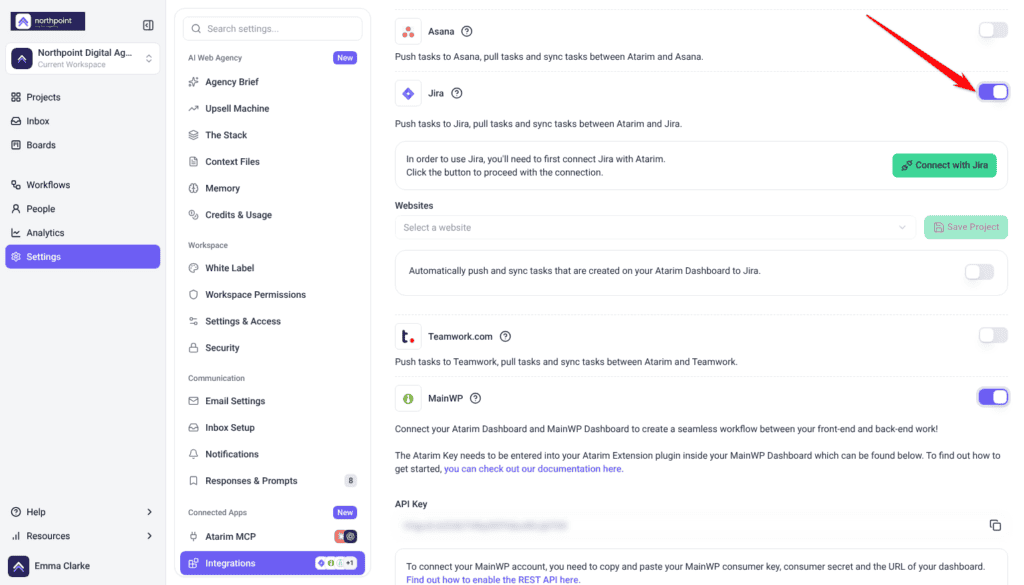
- Find Jira and switch its toggle on. Before it is connected, the panel explains that you need to connect your Jira account first and to use the button to proceed.
- Select Connect with Jira. Atlassian opens a page headed Atarim is requesting access to your Atlassian account.
- Check the site shown under Use app on is the Jira site you mean.
- Review the access being requested, then select Accept. You are returned to Atarim. The Jira card now reads Jira is connected to Atarim, with a Manage Connection button.
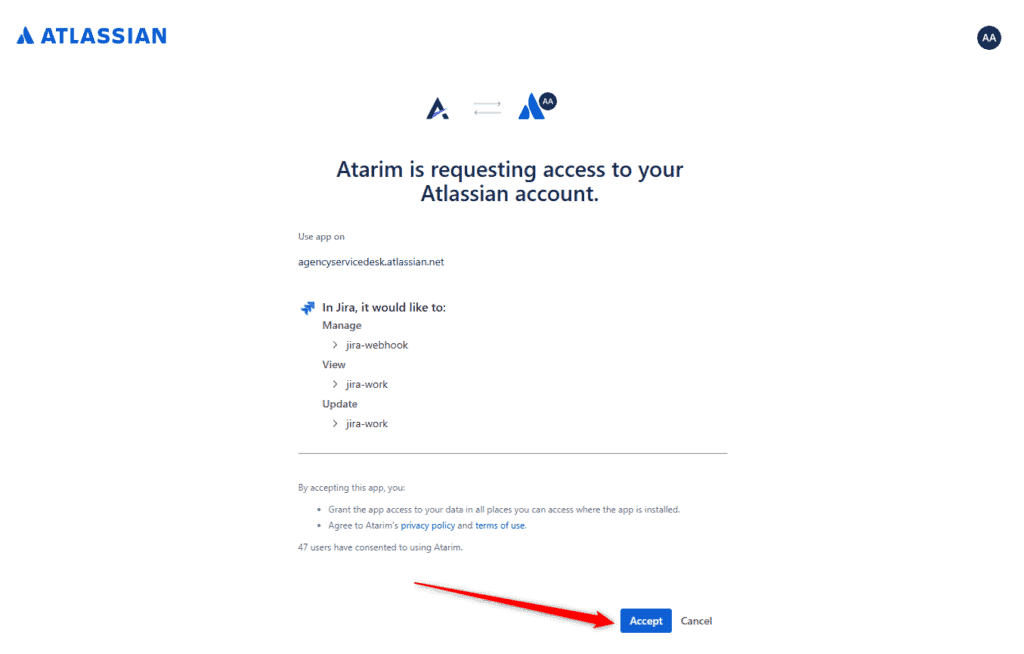
manage jira-webhook, and view and update jira-work. Accepting grants access to your data in all places you can access where the app is installed, and agrees to Atarim’s privacy policy and terms of use.
Choose the Atlassian Site and Jira Project
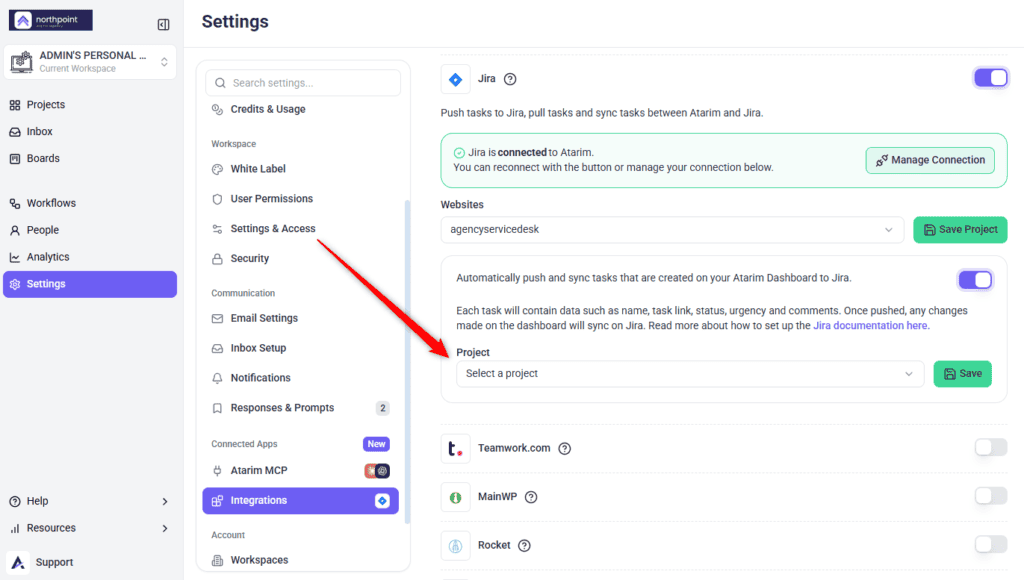
Configuration happens in two saves, which is easy to miss because they look similar. First you pick the Atlassian site, then you pick the Jira project your tasks feed.
1. Select the Atlassian Site
This is your Atlassian site — the Jira instance holding the projects Atarim can see. Despite the label, it is not a list of your Atarim websites.
Instructions:
- Under Websites, open the dropdown showing Select a website.
- Choose the Atlassian site that holds the project you want.
- Select Save Project. Despite its name, this stores the Atlassian site, not the Jira project — that comes next.
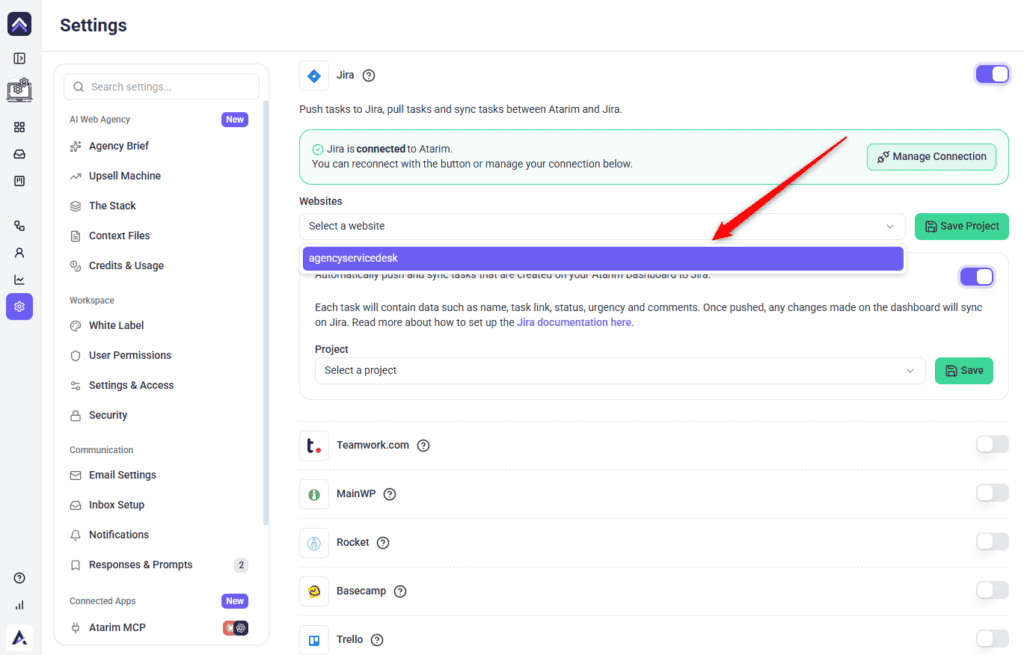
2. Turn On Syncing and Pick the Jira Project
Once syncing is on, new tasks from this workspace go to the Jira project you choose.
Instructions:
- Switch on the option to automatically push and sync tasks created on your Atarim dashboard to Jira.
- Under Project, open the dropdown showing Select a project and choose the Jira project.
- Select Save. Tasks from this workspace now push to the chosen Jira project.
- There is one setting per workspace, so this is done once — saving again replaces the previous choice.
What Gets Pushed
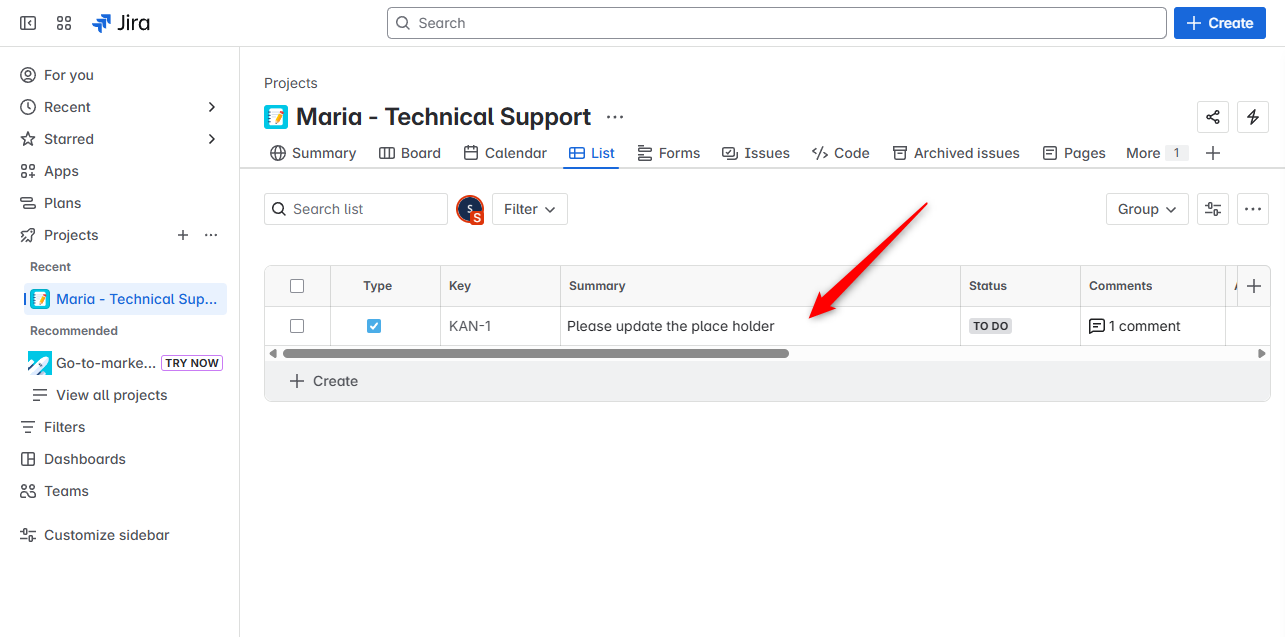
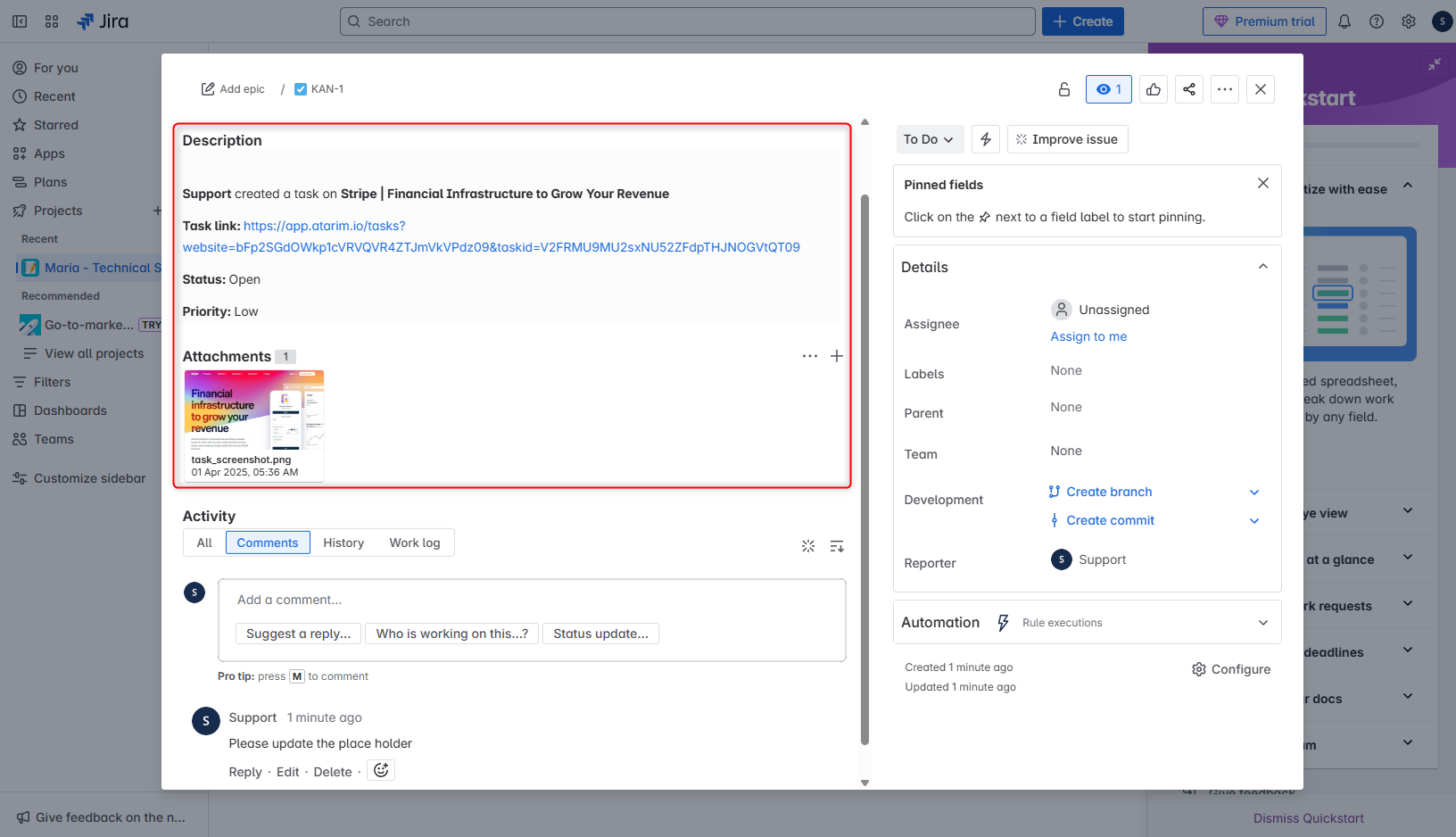
Each task pushed to Jira carries its name, a link back to the task, its status, its urgency and its comments. After the initial push, changes made on the Atarim dashboard continue to sync across to Jira.

Using Jira in a Workflow
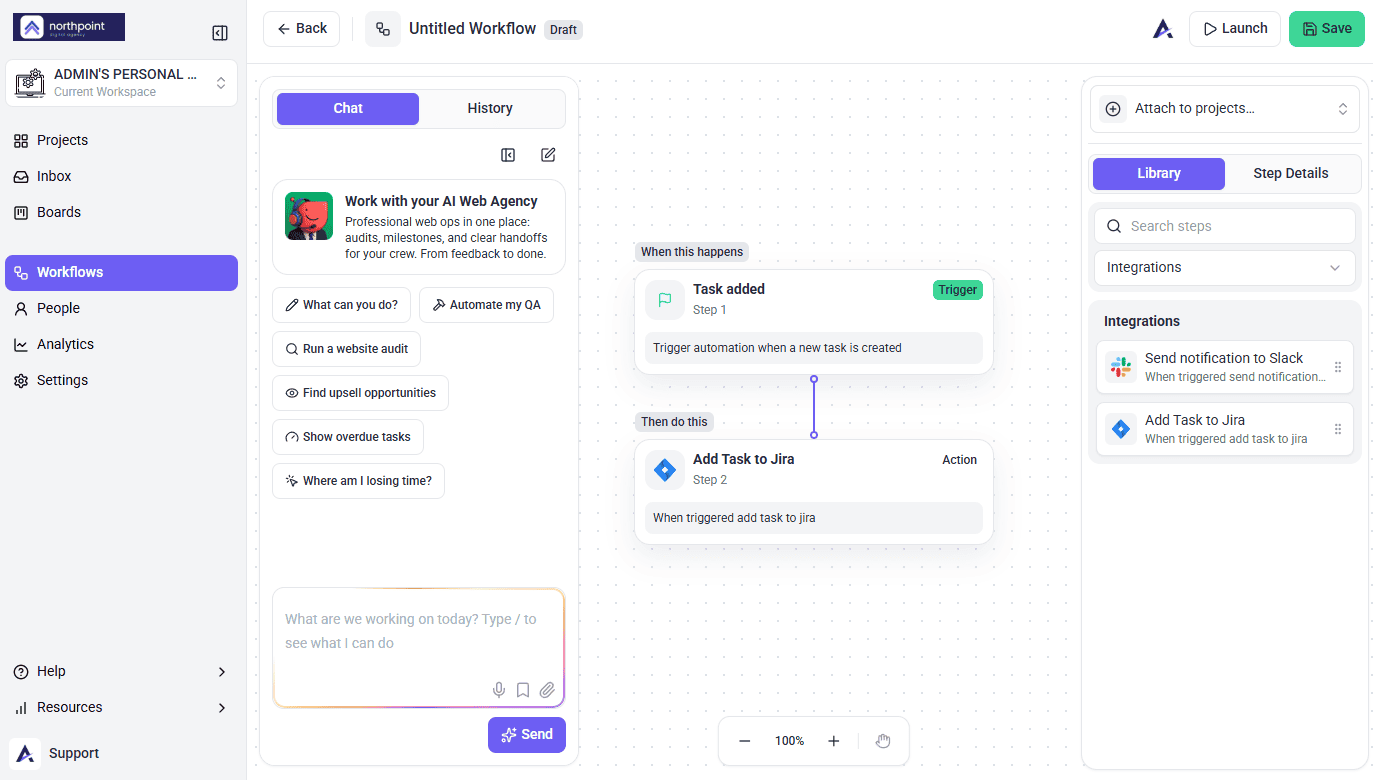
The automatic sync above pushes every new task from the workspace. If you would rather be selective, Jira is also available as an action inside Workflows — so you can send only the tasks that meet conditions you set.
Instructions:
- Create or edit a workflow.
- Add the Add Task to Jira action, listed under Integrations.
- Choose the Project the task should be created in. A Jira project is required — the workflow will not validate without one.
- Save the workflow.
Pushing or importing tasks by hand
You can also push a single task to Jira yourself, or bring Jira work into Atarim.
- To push one task, open it in the Inbox and select the Integrations icon in the task toolbar. Choose Push to Jira, pick the project, then select Create Task on Jira.
- To import, open the Inbox’s More Actions menu and select Import Tasks › Import from Jira. Choose the Jira project and the Atarim project the tasks should land in, then select Import Tasks. Tick Create all tasks as Internal Tasks (not visible to clients) to keep them from clients. For the other options in the import window, see Importing tasks.
Setup at a Glance
| Step | Where it happens | What it needs |
|---|---|---|
| Switch Jira on | Atarim → Integrations | A plan that includes it, and permission to manage integrations. |
| Accept the access request | Atlassian | The right Atlassian site under Use app on. |
| Select the Atlassian site | Atarim | A connected Atlassian account. |
| Save Project | Atarim | An Atlassian site selected. |
| Turn on automatic syncing | Atarim | The Atlassian site saved. |
| Select the Jira project | Atarim | A live connection, so projects can load. |
| Save | Atarim | A project selected. |
Benefits
| Benefit | In practice |
|---|---|
| Feedback reaches the backlog | Client requests arrive where development work is actually planned. |
| Tasks go both ways | Push tasks to Jira, and import Jira issues into Atarim. |
| Choose the destination per push | Manual pushes and workflow actions can each target a different Jira project. |
| Context travels with the task | Issues arrive with the task’s details rather than a bare title. |
| Clients stay in Atarim | They never need a Jira seat for their feedback to be tracked. |
Example Use Cases
| Situation | How to set it up |
|---|---|
| Developers plan sprints in Jira | Point the workspace at the delivery project so requests enter the backlog automatically. |
| Several clients, several Jira projects | Give each client its own workspace, or push manually and pick the project per batch. |
| Clients giving visual feedback | Let them work in Atarim while issues appear in Jira. |
| Separating client work from internal work | Point the workspace at a dedicated project rather than a shared one. |
| Reporting from Jira | Sync feedback in so client requests appear in existing reports. |
FAQs
Can Jira issues come into Atarim?
Yes. Use Import Tasks to bring Jira issues into the Atarim project you choose.
Can different websites use different Jira projects?
Not through the automatic sync — that stores one Jira project per Atarim workspace, and saving again replaces the previous choice. You can still send work to different projects: push a task or a bulk selection manually and choose the project at that point, add a Jira action inside a workflow, or use a separate workspace per client. Pulling issues in from Jira is also per-project and lands in the Atarim project you choose.
Do I need to create the Jira project first?
Yes. Atarim can only choose from projects that already exist in your connected Jira account.
What does Atarim push to Jira?
The task name, a link back to it, its status, urgency and comments. Later dashboard changes continue syncing across.
Why is the Save button greyed out?
Because no Jira projects have loaded. That usually means the connection is not returning data — reconnect and try again.
Do clients need a Jira account?
No. Clients work in Atarim; syncing happens between your two accounts.
Can I send only some tasks to Jira?
Yes. Use the Add Task to Jira action inside a workflow instead of the workspace-wide sync, so only tasks meeting your conditions are pushed. You can also push individual tasks or a bulk selection by hand.
Can I change the mapping later?
Yes. Choose a different project and select Save again. It replaces the setting for the whole workspace.
What if the connection breaks?
Use the reconnect option in the Jira row of the Integrations panel.
Common issues
- The Project list is empty and Save is disabled — Atarim cannot retrieve your Jira projects. Reconnect the integration.
- The Jira option is locked — your plan does not include native integrations. The lock names the minimum plan required.
- Integrations is not in your settings sidebar — your role does not have access. Ask an Administrator.
- Your project is not in the list — create it in Jira first, then reconnect so the list refreshes.
- Tasks are not reaching Jira — confirm you used both saves (Save Project for the Atlassian site and Save for the Jira project) and that automatic syncing is switched on.
- Tasks landed in the wrong project — the mapping points elsewhere. Change it and save again.
- Issues are being created twice — automatic sync is on and a workflow is also pushing the same tasks to Jira. Use one or the other.
- The workflow will not save — a Jira project is required on the action. Choose one before saving.
- The wrong Jira site got connected — the site under Use app on was the wrong one. Use Manage Connection to reconnect and accept on the right site.
- You cannot authorise Atarim in Jira — your Jira account may not have permission to approve apps. Ask a Jira admin.
Conclusion
Jira setup is short but has one detail that catches people out: automatic sync uses one Jira project for the whole workspace. Connect the account, choose the Atlassian site, then the Jira project. Use manual pushes or a workflow when some work needs a different project.
Point the mapping at a project your team genuinely grooms — syncing runs continuously once configured, and an unwatched project quietly fills up.
Tips & best practices
- Create the Jira project before you start, so it is selectable during setup.
- Use a project your team actively grooms.
- Use both saves — Save Project for the Atlassian site, then Save for the project.
- Reconnect rather than reinstall if projects stop loading.
- Choose either automatic sync or a workflow for the same tasks, not both.